Teeth Whitening Mouth Guard: How Whitening Trays Work
Whitening trays look like mouthguards, but their job is to hold gel on the enamel and off the gums, so fit and gel strength both matter.
Editorially reviewed.

A teeth whitening mouth guard is a thin, custom-made plastic tray that holds bleaching gel against your teeth during take-home whitening. It isn’t the same as a sports mouthguard, and how well it fits affects both comfort and gum safety.
People often call whitening trays “mouth guards” because they look similar: a clear shell that slips over the teeth. The NHS describes dentist-supplied trays as being made to fit closely around your teeth, like a mouthguard. The job is different, though. A sports guard is built to absorb knocks. A whitening tray only needs to hold a small amount of gel where it should be, on the tooth surface and away from the gums. For a broader look at in-chair and take-home options, see our guide to how teeth whitening works in Australia.
What does a whitening tray actually do?
The Australian Dental Association (ADA) explains that take-home whitening uses custom-made thin plastic trays that fit only your teeth. You put whitening gel into the tray and wear it at home under your dentist’s supervision. Your dentist tells you how much gel to use, how long to wear the trays each day and how many weeks to continue.
The gel does the whitening, not the tray. According to the ADA, the main whitening ingredients in products used in Australia are hydrogen peroxide, carbamide peroxide and phthalimidoperoxycaproic acid (PAP). The tray simply keeps that gel in contact with the enamel for the set time.
Take-home whitening is slower than in-chair treatment. The ADA notes, however, that the final result isn’t necessarily better or worse than whitening done in the clinic. The NHS suggests a home course usually runs over about 2 to 6 weeks.
Custom tray or one-size-fits-all: what’s the difference?
Over-the-counter whitening products may come with generic trays. The ADA’s guidance on sports mouthguards gives a useful comparison of how fit differs between types of mouth appliance, even though sports guards serve a different purpose:
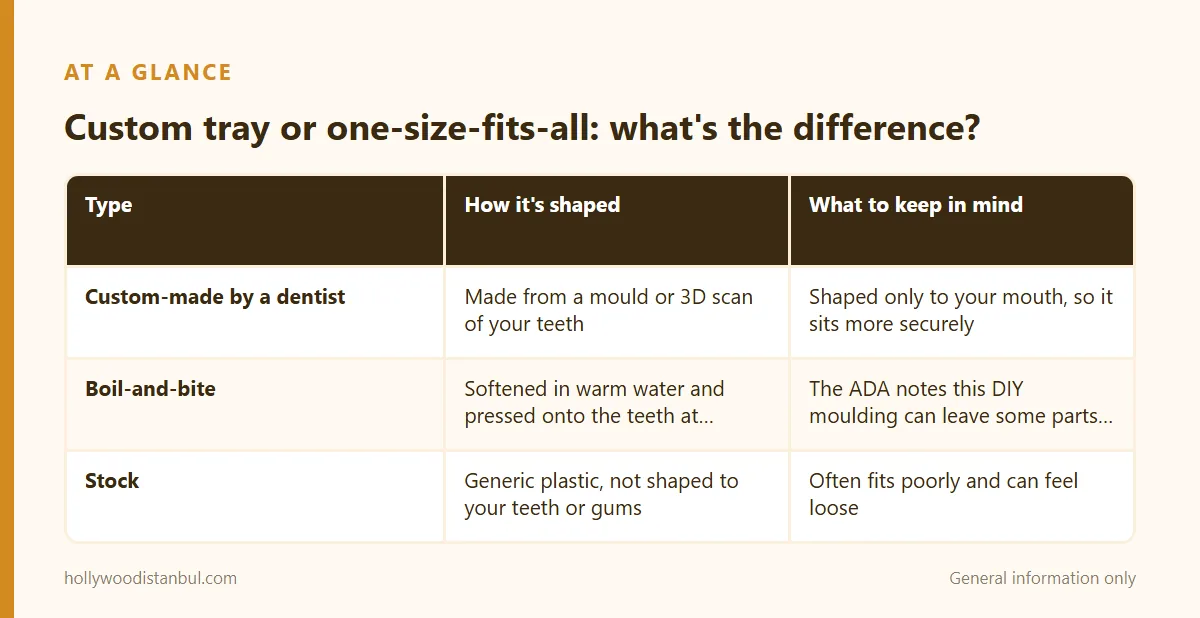
| Type | How it’s shaped | What to keep in mind |
|---|---|---|
| Custom-made by a dentist | Made from a mould or 3D scan of your teeth | Shaped only to your mouth, so it sits more securely |
| Boil-and-bite | Softened in warm water and pressed onto the teeth at home | The ADA notes this DIY moulding can leave some parts thinner than others |
| Stock | Generic plastic, not shaped to your teeth or gums | Often fits poorly and can feel loose |
For whitening, fit matters because of where the gel ends up. The ADA warns that whitening gel touching the soft tissues can cause chemical burns, and that burns on the lips, gums or tongue often turn into ulcers before they heal. A tray that sits loosely gives gel more room to escape onto the gums. When you collect custom trays, the NHS says the dentist checks that they fit well, explains how often to wear them and shows you how to protect your gums.
What strength of gel can go in the tray in Australia?
Gel strength is where the line between home and professional use is drawn. The ADA’s policy statement on whitening says products containing more than 6% hydrogen peroxide, or more than 18% carbamide peroxide, should only be supplied and used by registered dental practitioners who are trained and competent in whitening. The same policy explains that carbamide peroxide is about one-third as strong as hydrogen peroxide, which is why the two limits differ.
Within that framework, the ADA policy notes that suitably trained dental practitioners can supply custom-fitted trays for self-administered home use under their guidance. It also raises concerns about whitening offered by non-dental providers in salons, kiosks and mobile settings.
If someone other than your dentist is offering whitening, you can check whether a person is a registered dental practitioner on the public register run by the Australian Health Practitioner Regulation Agency (Ahpra).
Possible side effects of tray whitening
Side effects are usually linked to the chemicals rather than the tray itself. Sources describe the following:
- Sensitivity: the ADA says whitening can make teeth sensitive to cold, sometimes severely, and that your dentist should advise you on preventing or treating it before you start.
- Gum and throat irritation: the NHS lists sore gums or throat and white patches on the gums as possible effects.
- Soft-tissue burns: gel on the lips, gums or tongue can cause chemical burns, according to the ADA.
The NHS notes that side effects may be short-lived. Ongoing pain, gum damage that doesn’t settle, or ulcers that don’t heal are reasons to stop and contact your dentist.
Who should check with a dentist before using trays?
Some people are advised against whitening altogether. The ADA does not recommend teeth whitening for women who are pregnant or breastfeeding. There’s no evidence it’s harmful, but also no evidence it’s safe. The NHS also lists people with unhealthy teeth or gums and young people aged 17 or under among those for whom whitening isn’t recommended.
Existing dental work matters too. Whitening gel only lightens natural enamel. The ADA notes that porcelain crowns, veneers and white composite fillings won’t change colour, so they may stand out after whitening. If that happens, your dentist may need to replace them. Talk about this before you start.
How should you look after whitening trays?
Ask your dentist how to clean your particular trays, because materials vary. The ADA’s general care advice for custom sports mouthguards is a sensible starting point for any custom plastic mouth appliance:
- Keep it out of direct sunlight.
- Wash it in cool or warm water.
- Store it dry in a protective case.
If you plan to reuse your trays for top-up whitening later, ask your dentist to check them first. Results also fade over time: the NHS says the effect may last around three years if you follow your dentist’s advice. What you eat in the first couple of days matters as well. Our 48-hour eating plan after whitening covers that.
Frequently asked questions
Can I use my sports mouthguard for whitening?
A sports mouthguard is designed to absorb impacts, not to hold gel against the enamel. The ADA describes whitening trays as thin, custom-made trays that fit only your teeth. Ask your dentist rather than adapting another appliance.
Are shop-bought whitening kits with trays safe?
The ADA says DIY kits sold online, in supermarkets and in pharmacies carry risks, and recommends having whitening done under a dentist’s supervision. The NHS likewise says shop and online kits may not work as well and may harm teeth and gums.
How long do I wear the tray each day?
It depends on the gel and its strength. Your dentist sets the amount of gel, the daily wear time and the number of weeks for your treatment.
Will the tray whiten my crowns or veneers?
No. Whitening only lightens natural tooth enamel, so crowns, veneers and white fillings stay the same shade.
Sources
- Australian Dental Association, Teeth whitening
- Australian Dental Association, Policy Statement 2.2.8 – Teeth Whitening (Bleaching) by Persons other than Dental Practitioners
- Australian Dental Association, Sports mouthguards
- NHS, Teeth whitening
- Ahpra, Register of practitioners
This article is general information and doesn’t replace advice from your own dentist.