Teeth Whitening Kit: Australian Limits, Risks and Results
Peroxide limits for consumer kits, how they compare with professional whitening and the risks.
Editorially reviewed.
A teeth whitening kit sold to consumers in Australia can contain no more than 6% hydrogen peroxide or 18% carbamide peroxide. Stronger gels are for dental practitioners only. Over-the-counter kits are less effective than dentist-supervised whitening and carry risks such as sensitivity and gum burns.
Whitening kits are easy to buy at the supermarket, the chemist or online, which makes them tempting. Before you spend, it is worth knowing what the rules allow, what a kit can realistically do and when a dentist-supervised option makes more sense.
What are the legal limits for whitening kits in Australia?
The Australian Dental Association (ADA) policy on whitening (approved April 2026) explains the national Poisons Standard. Hydrogen peroxide at 3 to 6% and carbamide peroxide at 9 to 18% are Schedule 5 substances, which can be sold to consumers if labelled with safety warnings. Products containing more than 6% hydrogen peroxide or 18% carbamide peroxide fall under Schedule 10 and are restricted to registered dental practitioners.
If a kit sold online claims a higher strength than these limits, treat that as a red flag.
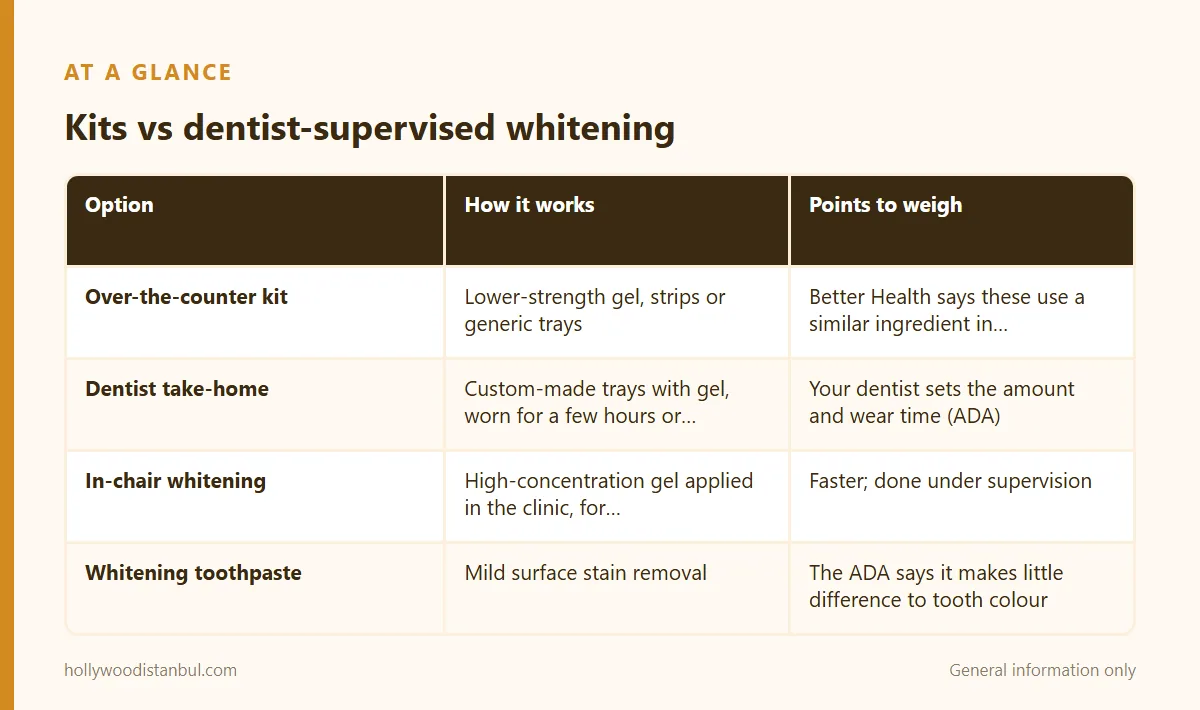
Kits vs dentist-supervised whitening
| Option | How it works | Points to weigh |
|---|---|---|
| Over-the-counter kit | Lower-strength gel, strips or generic trays | Better Health says these use a similar ingredient in smaller amounts, so are less effective |
| Dentist take-home | Custom-made trays with gel, worn for a few hours or overnight for about one to two weeks | Your dentist sets the amount and wear time (ADA) |
| In-chair whitening | High-concentration gel applied in the clinic, for about an hour | Faster; done under supervision |
| Whitening toothpaste | Mild surface stain removal | The ADA says it makes little difference to tooth colour |
What are the risks of home whitening kits?
The ADA’s whitening page lists:
- Chemical burns: peroxide gel touching the lips, gums or tongue can cause burns, which often turn into ulcers.
- Sensitivity: teeth may become sensitive to cold, sometimes severely.
- Mismatched restorations: porcelain crowns, veneers and white fillings will not change colour.
- Pregnancy and breastfeeding: whitening is not recommended, as there is no evidence either way on safety.
The ADA policy adds that misusing heat or light with peroxide may cause nerve damage to the tooth and burns to soft tissues. The ADA recommends whitening under dental supervision.
Will a whitening kit work on my teeth?
It depends on the cause. The ADA explains that surface stains from coffee, tea, red wine and smoking respond to whitening, but some stains sit inside the tooth, and Better Health notes some discolouration does not respond at all. Decay, fillings, crowns and veneers do not whiten either. A quick check-up tells you whether whitening is likely to help and whether any decay needs treating first.
Checklist before buying a whitening kit
- Check the peroxide strength is within the 6% hydrogen peroxide or 18% carbamide peroxide limit.
- Make sure the pack carries safety warnings and instructions.
- Have a dental check first if you have sensitive teeth, gum problems or visible restorations.
- Follow the wear time exactly; more is not better.
- Stop and see a dentist if you get gum soreness, ulcers or strong sensitivity.
- Skip whitening if you are pregnant or breastfeeding.
How long do results last?
Better Health says whitening results are not permanent. Brushing twice a day, flossing daily, not smoking, limiting strongly coloured food and drink, and a professional clean every 6 to 12 months help them last longer. For the professional route, see how teeth whitening works in Australia and our whitening cost guide.
Sources
- Australian Dental Association, Policy Statement 2.2.8: Teeth Whitening/Bleaching by Persons Other Than Dental Practitioners
- Australian Dental Association, Teeth Whitening
- Australian Dental Association, Teeth Staining
- Better Health Channel (Victorian Government), Cosmetic dentistry and teeth whitening
This article is general information and is not a substitute for advice from your own dentist.