Clear Aligners: How They Work and Who They Suit
How aligner trays move teeth, daily wear, treatment length and the risks of at-home kits.
Editorially reviewed. Dental review: scheduled, not yet completed for this article.

Clear aligners are custom-made, removable plastic trays that gradually straighten crowded or crooked teeth. Cleveland Clinic says they are worn 22 to 23 hours a day and swapped about every two weeks, and an orthodontist decides whether they suit you.

Brands such as Invisalign and ClearCorrect have made “invisible braces” familiar, and they are now sold in Australia both through orthodontists and dentists and through direct-to-consumer companies. The tray is only part of the treatment, though. Planning, supervision and your own discipline make the difference.
How do clear aligners move teeth?
Each set of trays is shaped slightly differently from the last, so wearing them in sequence nudges teeth step by step towards the planned position. Cleveland Clinic describes the process as starting with digital images or moulds of your teeth, from which a series of aligners is made. You change to a new set roughly every two weeks, and the orthodontist checks progress and fit at follow-up visits.
The Australian Society of Orthodontists (ASO), quoted by CHOICE, adds a detail many people do not know: some teeth need small attachments bonded to them so the aligners can grip and move them properly. Without those, certain movements may not work as intended.
Who are clear aligners suitable for?
According to Cleveland Clinic, clear aligners treat crowded or crooked teeth and some types of mild to moderate malocclusion, meaning the upper and lower teeth do not meet properly. They are not right for everyone, and traditional braces may correct some problems faster.
Before any tooth movement, the ASO stresses the importance of an examination with X-rays. Without one, problems such as gum disease, bone loss, cracked teeth, decay, extra teeth, cysts or tumours can go unnoticed.
What is daily life with aligners like?
- Wear time: 22 to 23 hours a day. Cleveland Clinic is blunt that the aligners only work if you wear them as directed.
- Eating and drinking: trays come out to eat and drink, and to brush and floss.
- Storage: keep them somewhere safe whenever they are out, so they are not lost or damaged.
- Comfort: pressure or soreness is common, especially with each new set, and usually eases within a few days.
- Hygiene: Cleveland Clinic notes aligners generally involve fewer restrictions and extra hygiene steps than fixed braces.
Contact your orthodontist if you have sharp pain, pain lasting more than a few days, bleeding or swollen gums, or a tray that feels loose or does not fit, Cleveland Clinic advises.
How long does clear aligner treatment take?
Cleveland Clinic says slight crookedness may take up to nine months to correct, while more complex problems can take several months longer. Your orthodontist will give you an estimate after planning your case.
Are at-home aligner kits a good idea?
Professional bodies in Australia urge caution. In CHOICE’s reporting, the ASO warned that quick cosmetic fixes may not address bite problems and can sometimes make them worse, and suggested online-only aligners may only suit young adults with healthy teeth and gums, a normal bite and very minor crowding. The Australian Dental Association said improperly done treatment can cause permanent damage to the teeth, gums, jaw or jaw joints, and recommended at least a face-to-face consultation with a dentist or orthodontist first.
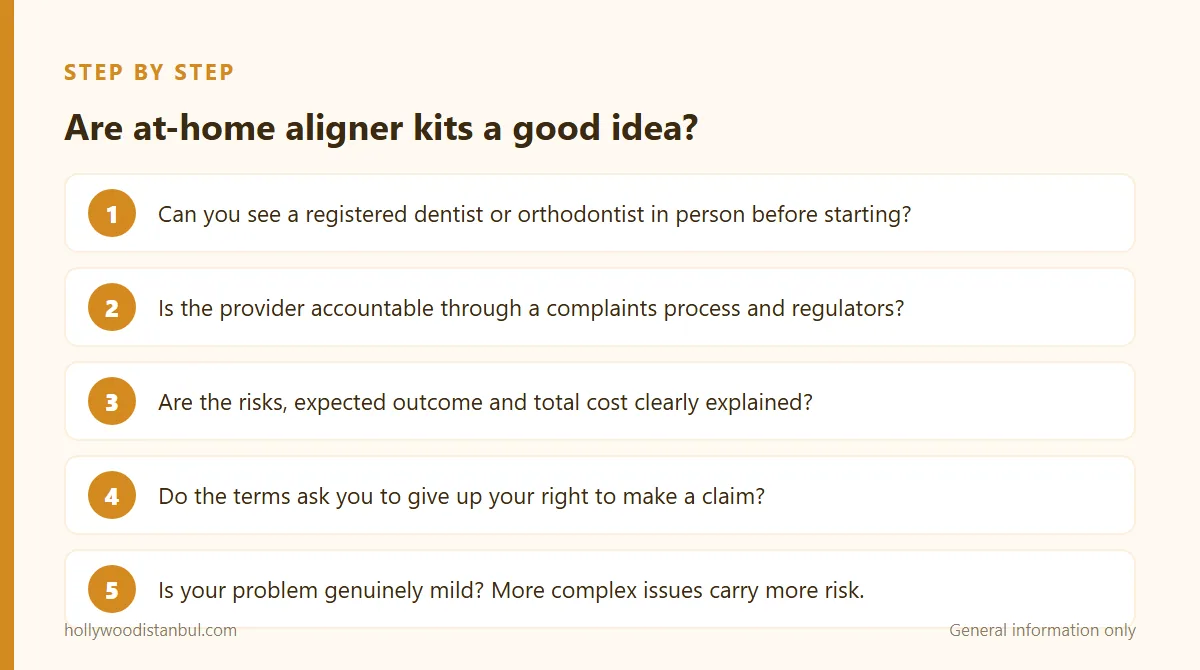
CHOICE’s checklist before buying any aligner treatment:
- Can you see a registered dentist or orthodontist in person before starting?
- Is the provider accountable through a complaints process and regulators?
- Are the risks, expected outcome and total cost clearly explained?
- Do the terms ask you to give up your right to make a claim?
- Is your problem genuinely mild? More complex issues carry more risk.
Straightening is often one step in a broader plan. Our guides to what happens during a smile makeover and payment plans for dental treatment in Australia may help you plan.
Sources
- Cleveland Clinic, Clear Aligners
- CHOICE, article on direct-to-consumer teeth straightening (updated December 2020; comments from the Australian Society of Orthodontists and the Australian Dental Association)
This article is general information and is not a substitute for advice from your own dentist.