Whitening Toothpaste: What It Can and Can’t Do
How whitening pastes work, whether they are safe for enamel and when you need something stronger.
Editorially reviewed. Dental review: scheduled, not yet completed for this article.

Whitening toothpaste mainly removes surface stains rather than changing tooth colour. Most use mild abrasives to polish stains away, and some add low-strength peroxide. The Australian Dental Association says these pastes tend not to make a large difference to tooth colour.
That does not make them useless. For coffee, tea or wine marks on otherwise healthy enamel, a whitening paste can help keep teeth looking fresher between dental cleans. The trick is matching expectations to what the product can actually do, and knowing when a different approach makes more sense.
How does whitening toothpaste work?
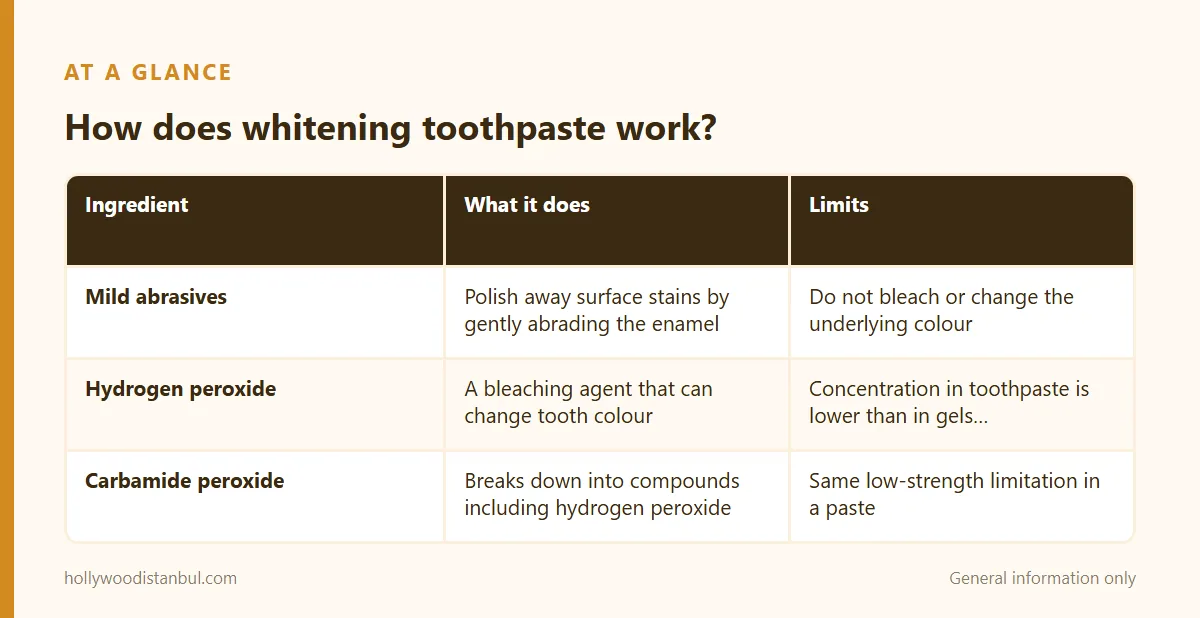
Colgate’s guide to whitening toothpaste describes three main types of active ingredient:
| Ingredient | What it does | Limits |
|---|---|---|
| Mild abrasives | Polish away surface stains by gently abrading the enamel | Do not bleach or change the underlying colour |
| Hydrogen peroxide | A bleaching agent that can change tooth colour | Concentration in toothpaste is lower than in gels, pens or strips; results build over a longer period |
| Carbamide peroxide | Breaks down into compounds including hydrogen peroxide | Same low-strength limitation in a paste |
Colgate notes that bleaching toothpastes typically work faster and give longer-lasting results than paste that only removes surface stains. The ADA lists hydrogen peroxide, carbamide peroxide and phthalimidoperoxycaproic acid (PAP) as the active ingredients used in whitening products generally, and points out that dentists can use much higher-strength gels than products sold for home use.
Is whitening toothpaste safe for enamel?
Abrasiveness is measured with a score called RDA (relative dentin abrasivity). Colgate, citing the American Dental Association, says any toothpaste with an RDA below 250 is considered safe and that most whitening toothpastes sit below 200. A few habits still help protect your teeth:
- Use a soft-bristled brush and a gentle technique. Colgate specifically warns against hard scrubbing.
- If your teeth become sensitive, alternate with a regular toothpaste or choose a whitening paste designed for sensitive teeth.
- Check that the paste contains fluoride. Cleveland Clinic recommends a soft-bristled brush and a fluoride toothpaste for preventing discolouration.
The ADA also notes that whitening toothpaste can cause sensitivity, and it advises against using homemade baking soda pastes as part of a daily brushing routine.
Will whitening toothpaste work on crowns, veneers or fillings?
No. Colgate states that whitening toothpastes cannot whiten veneers, crowns or other dental restorations. The ADA says the same about professional whitening: it does not change the colour of porcelain crowns, veneers or composite resin (white) fillings. If you have restorations on your front teeth, brightening the surrounding natural teeth could leave them looking mismatched. Colgate suggests talking to a dentist first, especially if you have crowns and fillings.
When is whitening toothpaste not enough?
Toothpaste works on the outside of the tooth. Some discolouration starts deeper. Cleveland Clinic separates stains into:
- Extrinsic stains, on the outer surface, usually from food and drink such as coffee, tea, red wine, berries and soy sauce.
- Intrinsic stains, inside the tooth and affecting the dentin, which can follow dental trauma or some medications.
Cleveland Clinic also explains that enamel thins with age and exposes the yellowish dentin underneath. A paste that polishes the surface will not change that. Options for deeper or age-related colour change include dentist-supervised whitening, bonding, veneers or crowns, depending on the tooth.
See a dentist promptly rather than reaching for a whitening product if a single tooth suddenly darkens. Cleveland Clinic notes this often signals decay or injury, and a tooth can turn grey when its nerve dies.
How do you get the best from a whitening toothpaste?
- Brush twice a day for two minutes, as Cleveland Clinic recommends, and floss daily.
- Rinse with water after coffee, tea, cola or red wine.
- Wait about an hour before brushing after citrus, soft drink or lollies, as Cleveland Clinic advises, to avoid brushing softened enamel.
- Keep regular professional cleans, which remove stain and tartar a paste cannot.
If you want a bigger change, our guides to how professional teeth whitening works in Australia and what it costs explain the next step up.
Sources
- Colgate, Whitening Toothpaste 101: The Basics of Daily Whitening
- Australian Dental Association, Teeth Whitening
- Cleveland Clinic, Tooth Discoloration
This article is general information and is not a substitute for advice from your own dentist.