Composite Bonding Before and After: Setting Expectations
What bonding can change, how to prepare and how results age over time.
Editorially reviewed. Dental review: scheduled, not yet completed for this article.

Composite bonding before and after photos usually show chips repaired, small gaps closed or discoloured patches hidden with tooth-coloured resin in a single visit. What they do not show is the planning beforehand, the limits of what resin can change, or the touch-ups most bonding needs within a few years.
If you are considering bonding, it helps to think in three stages: what to sort out before the appointment, what a realistic result looks like on the day, and how the “after” changes over the following years.
What can bonding realistically change?
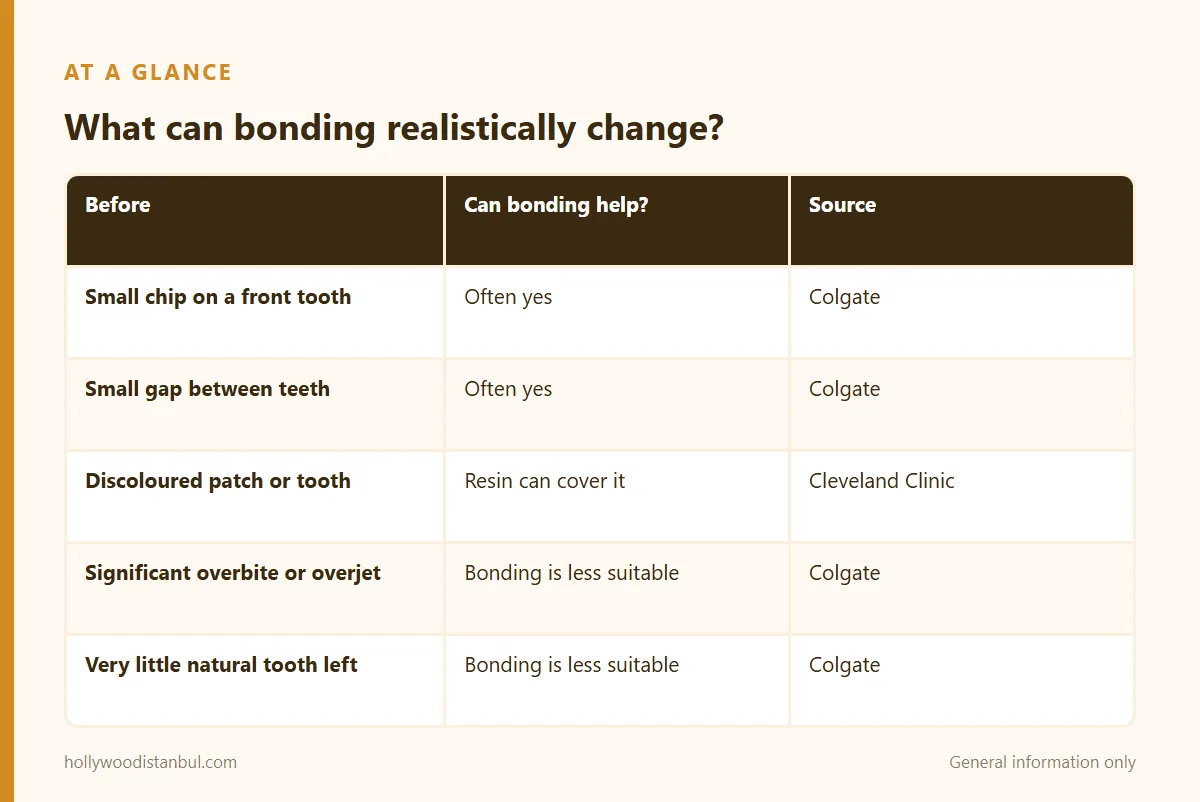
Colgate describes composite bonding as adding material to a tooth to change or supplement its shape, and lists good candidates as people wanting to improve the look of a tooth or close gaps, or who have a chipped, fractured or decayed tooth or an exposed root. Cleveland Clinic notes resin can be used to hide discoloured teeth.
| Before | Can bonding help? | Source |
|---|---|---|
| Small chip on a front tooth | Often yes | Colgate |
| Small gap between teeth | Often yes | Colgate |
| Discoloured patch or tooth | Resin can cover it | Cleveland Clinic |
| Significant overbite or overjet | Bonding is less suitable | Colgate |
| Very little natural tooth left | Bonding is less suitable | Colgate |
What should you do before the appointment?
- Decide about whitening first. The Australian Dental Association states whitening does not change the colour of composite resin. If you want lighter teeth, whiten before bonding so the resin can be matched to the new shade.
- Have a check-up. Your dentist can identify any decay or gum problems that should be dealt with before cosmetic work.
- Ask to talk through the plan. Ask which teeth will be bonded, how much will change, and what the dentist expects the result to look like.
What happens on the day?
According to Colgate, the dentist smooths the tooth surface, applies a conditioning liquid, places the resin and hardens it with a special light, then shapes the material and checks your bite. Citing Cleveland Clinic, Colgate says bonding one tooth typically takes between half an hour and an hour, it is often done in one visit, and local anaesthetic may not be needed. Colgate also notes bonding removes less natural tooth than crowns or veneers.
How does the “after” change over time?
Bonding is not a set-and-forget result. Colgate lists its drawbacks as being less stain resistant than other options, being prone to chipping or breaking, and generally having a shorter lifespan. Colgate, citing Cleveland Clinic, puts the lifespan of bonding materials at three to 10 years depending on oral hygiene, and Cleveland Clinic’s discolouration guide says touch-ups are typically needed every five to seven years.
To keep the after looking like the after, Colgate recommends:
- brushing twice a day for two minutes with non-abrasive toothpaste and a soft brush
- cleaning between teeth daily with floss, a flosser or interdental brush
- avoiding grinding, or asking about a night guard
- not chewing pens, ice or fingernails
- limiting sugary and acidic foods and drinks, and keeping regular check-ups
Cleveland Clinic adds that limiting tea, coffee, cola and red wine and rinsing with water afterwards helps reduce staining.
How do you judge before and after photos?
A photo captures one moment, so when looking at a practice’s examples, ask how long ago the work was done, whether any whitening was included, and how many teeth were treated. The ADA notes that a dentist cannot be registered as a “cosmetic dentist” in Australia, so look at experience and examples of the practitioner’s own work rather than titles. For costs and the full procedure, see composite bonding costs in Australia and our smile makeover guide.
Sources
- Colgate, Is Composite Resin Bonding Right For You?
- Cleveland Clinic, Tooth Discoloration
- Australian Dental Association, Teeth Whitening
- Australian Dental Association, Crowns, Bridges and Veneers
This article is general information and is not a substitute for advice from your own dentist.