Immediate Dentures: Pros, Cons and the First Months
How same-day dentures work, how they compare with conventional dentures and aftercare.
Editorially reviewed.

Immediate dentures are made before your teeth are removed and fitted on extraction day, so you are never without teeth while you heal. As gums and bone shrink, they often need adjusting or relining within a few months.
For many people facing extractions, the biggest worry is walking out of the clinic with a gap. Immediate dentures (sometimes called same-day dentures) solve that, but they come with trade-offs that are worth understanding before you agree to the plan.
How do immediate dentures work?
The Australian Dental Association (ADA) describes immediate dentures as dentures made before teeth are removed and placed in the mouth on the day of extraction. The Better Health Channel (Victorian Government) says they suit people who do not want to go without teeth for the two to three months it would otherwise take, and that the denture often becomes loose as the bone and gums change, so it may need adjusting or relining within a few months.
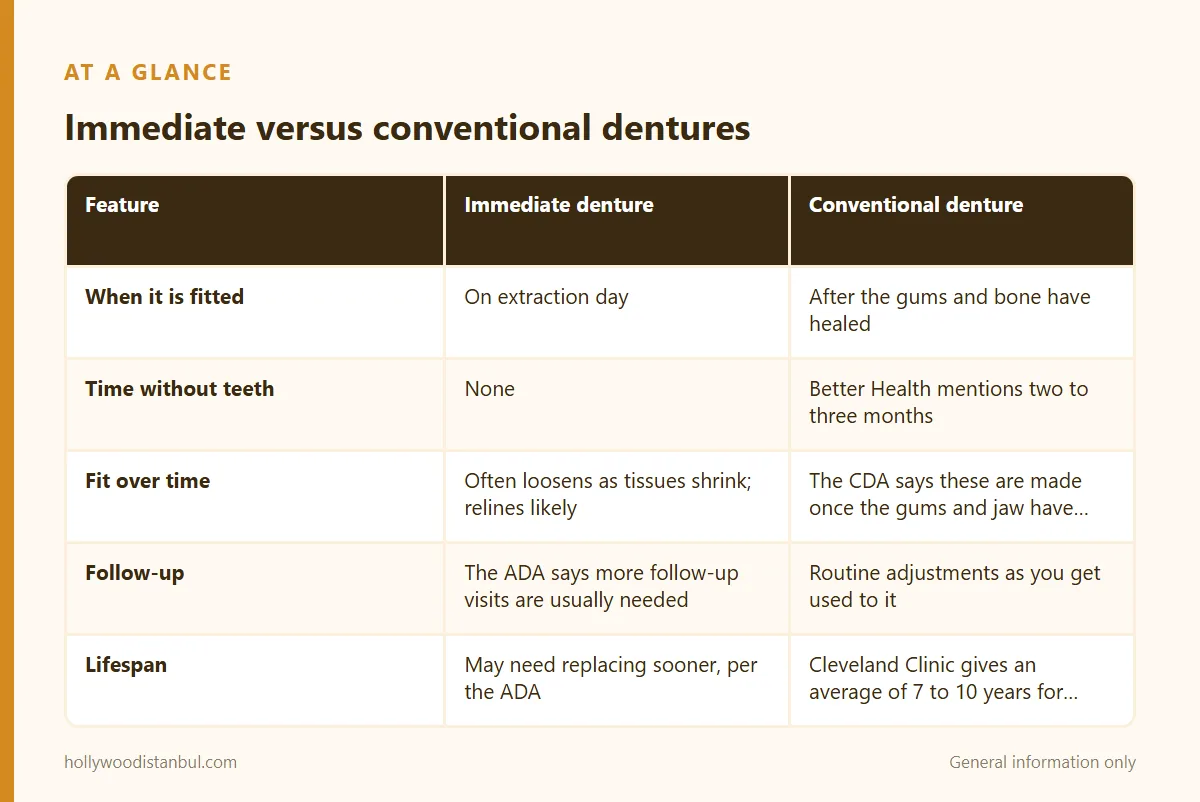
Immediate versus conventional dentures
| Feature | Immediate denture | Conventional denture |
|---|---|---|
| When it is fitted | On extraction day | After the gums and bone have healed |
| Time without teeth | None | Better Health mentions two to three months |
| Fit over time | Often loosens as tissues shrink; relines likely | The CDA says these are made once the gums and jaw have healed |
| Follow-up | The ADA says more follow-up visits are usually needed | Routine adjustments as you get used to it |
| Lifespan | May need replacing sooner, per the ADA | Cleveland Clinic gives an average of 7 to 10 years for dentures |
What does the process look like?
The Canadian Dental Association (CDA) outlines the sequence: measurements and jaw models are taken at the first visit, and the dentures are inserted right after the extractions. It notes healing can take up to six months, and bone and gum shrinkage may mean a reline is needed.
- Planning visit: your dentist or prosthetist takes impressions and measurements while your teeth are still in place.
- Making the denture: the denture is made from these records ahead of the extraction appointment.
- Extraction day: the teeth are removed and the denture is fitted straight away.
- Early reviews: sore spots are adjusted; Better Health advises returning as soon as possible if the denture presses on the gums.
- Reline or remake: once healing settles, the denture is relined, or sometimes replaced with a new one.
Cleveland Clinic notes that in some cases immediate dentures are temporary appliances replaced by final dentures once you have healed, while in others you can keep wearing the immediate denture long term.
What should you expect in the first weeks?
Cleveland Clinic says getting used to dentures can take weeks or sometimes months, and several adjustments in the first couple of weeks are normal. New dentures may press on the gums and cause sore spots, which is why the early reviews matter. Our guide to pain levels for dental procedures in Australia covers extraction recovery more broadly.
How do you care for immediate dentures?
- Follow your dentist’s instructions for the first day or two after extractions.
- Then clean the denture morning and night with a denture brush and liquid soap or denture cleaner; the ADA says toothpaste is too rough for plastic.
- Clean over a towel or a bowl of water in case you drop it.
- Take dentures out at night; Better Health says this lets the mouth rest and helps prevent fungal infections.
- Never use hot water, which Better Health warns can change the shape and fit.
- Brush your gums and any remaining teeth with a soft brush.
Questions to ask before choosing immediate dentures
- Is this denture intended to be temporary or my long-term set?
- How many review visits are included in the fee?
- Is a reline included, and when will it be done?
- Would implant-retained dentures be an option later?
The ADA lists implant-retained dentures, which are held in place by implants but can still be removed, as one of the main denture types. Compare the options in our article on dental implants versus dentures.
Sources
- Australian Dental Association, Dentures
- Better Health Channel (Victorian Government), Dentures
- Canadian Dental Association, Dentures
- Cleveland Clinic, Dentures
This article is general information and is not a substitute for advice from your own dentist or dental prosthetist.