Braces Brackets: Types, Care and Treatment Time
How brackets and wires work, the main types, care tips and what to ask about cost.
Editorially reviewed.

Braces brackets are the small squares glued to each tooth that hold the archwire. The wire runs through the brackets, held by rubber or wire ties, and applies gentle, steady pressure that moves teeth into position over months or years. Brackets can be metal, tooth-coloured ceramic, or fitted behind the teeth.
Most people picture “train tracks” when they think of braces, but the brackets themselves come in a few styles, and they need particular care while you wear them. This guide explains what brackets do, the main types available in Australia, how long treatment usually takes and how to look after them.
How do brackets and wires move teeth?
The Canadian Dental Association (CDA) explains the basic design: brackets (or sometimes bands) are glued to each tooth, and arch wires run through the brackets and are held in place with rubber or wire ties. Together they apply gentle, steady pressure that moves teeth into position over months or years. Your orthodontist adjusts the wire at regular visits; Healthdirect (Australian Government) says check-ups during treatment usually take 30 to 60 minutes.
What types of braces brackets are there?
Healthdirect lists traditional metal braces, clear or tooth-coloured braces, braces worn on the inside surface of the teeth, and clear removable aligners. The CDA adds that braces and elastics can even be multicoloured.
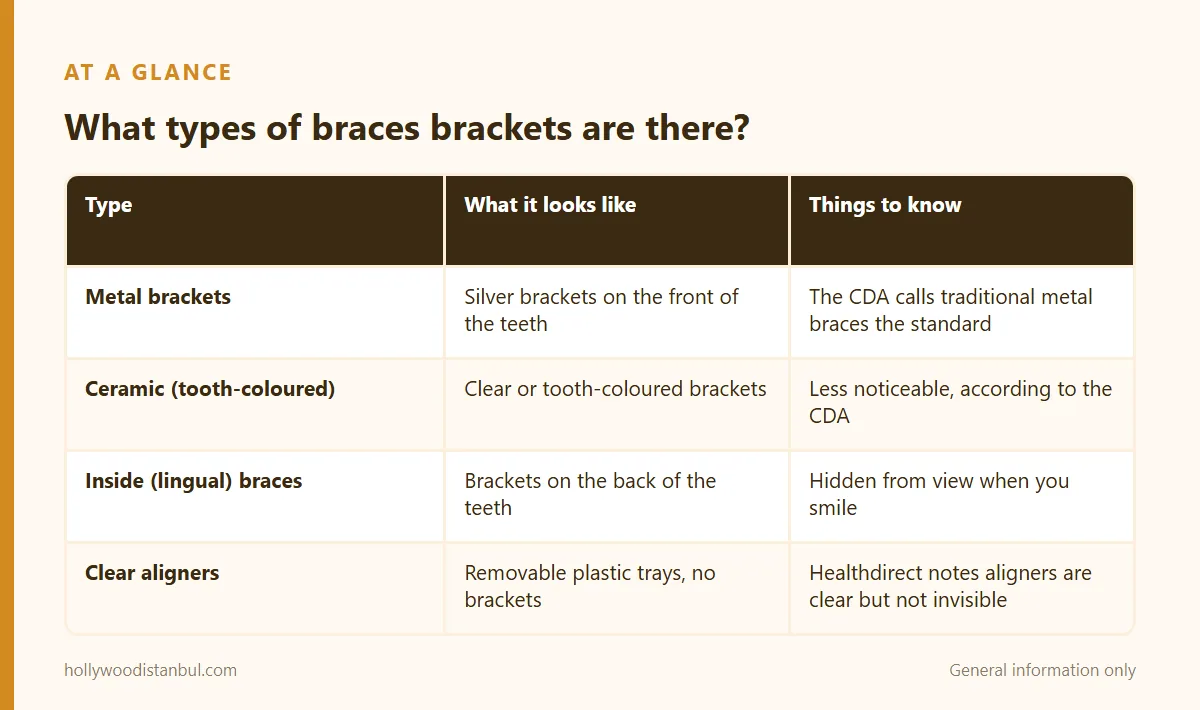
| Type | What it looks like | Things to know |
|---|---|---|
| Metal brackets | Silver brackets on the front of the teeth | The CDA calls traditional metal braces the standard |
| Ceramic (tooth-coloured) | Clear or tooth-coloured brackets | Less noticeable, according to the CDA |
| Inside (lingual) braces | Brackets on the back of the teeth | Hidden from view when you smile |
| Clear aligners | Removable plastic trays, no brackets | Healthdirect notes aligners are clear but not invisible |
Our separate guide to what happens during a smile makeover in Australia shows where orthodontics fits alongside other cosmetic treatment.
How long will you wear braces?
Healthdirect says treatment usually takes about 1 to 3 years. The CDA says most people wear braces for about 2 years and that adults generally take longer than children or teenagers. Orthodontists treat children, teens and adults, and many general dentists also provide some orthodontic treatment.
Do brackets hurt?
They can feel strange at first. Healthdirect says you may have some toothache or mild discomfort early on, and scratches or ulcers inside your mouth. The CDA suggests relief wax over brackets that rub your lips or cheeks, and soft foods after an adjustment. If discomfort does not settle, tell your orthodontist, who may be able to adjust the braces.
How do you look after brackets?
Plaque collects around brackets, and the CDA warns that plaque left behind can leave white or brown marks on the enamel that may be permanent. Healthdirect similarly says neglecting care can cause white spots or decay.
- Brush the front, back and chewing surfaces carefully, around every bracket.
- Use floss threaders to get under the wire.
- Avoid hard foods like ice and nuts, and sticky treats like toffee and chewing gum, which can loosen or pull off brackets.
- Do not chew pens or pencils.
- Limit sugary food and soft drink, as Healthdirect advises.
What if a bracket comes loose?
The CDA suggests contacting your dentist or orthodontist as soon as possible, because problems left unrepaired can lengthen treatment. A poking wire can sometimes be pushed back with a pencil eraser until your appointment.
What happens after the brackets come off?
Teeth tend to move back over time, so Healthdirect says you may need a retainer, worn only at night or all the time. The CDA notes retainers can be fixed to the teeth or removable.
How much do braces cost in Australia?
Healthdirect says costs vary, so ask for a quote and check whether it includes the assessment, X-rays and scans, the appliances, retainers and follow-up reviews. Health insurance may cover some costs; CHOICE reported an average extras benefit of $1,096 for braces on single policies. The Child Dental Benefits Schedule does not cover orthodontic treatment. See our guide on financing dental work in Australia.
Sources
- Healthdirect (Australian Government), Orthodontic treatments
- Canadian Dental Association, Orthodontics
- CHOICE, How much should you pay at the dentist? (updated 9 March 2023)
- Australian Dental Association, Child Dental Benefits Schedule
This article is general information and is not a substitute for advice from your own dentist or orthodontist.