One False Tooth: Your Options for a Single Gap
Partial denture, bridge or implant: how the single-tooth options compare.
Editorially reviewed.

If you need one false tooth, there are three main options: a partial denture that clips onto your other teeth, a bridge fixed to the neighbouring teeth, or a dental implant with a crown. Dentures usually cost least; implants need surgery.
Losing a single tooth is common, whether from decay, a crack or an accident. The right replacement depends on where the gap is, the health of the teeth around it, your bone and gums, and your budget. Here is how the options compare.
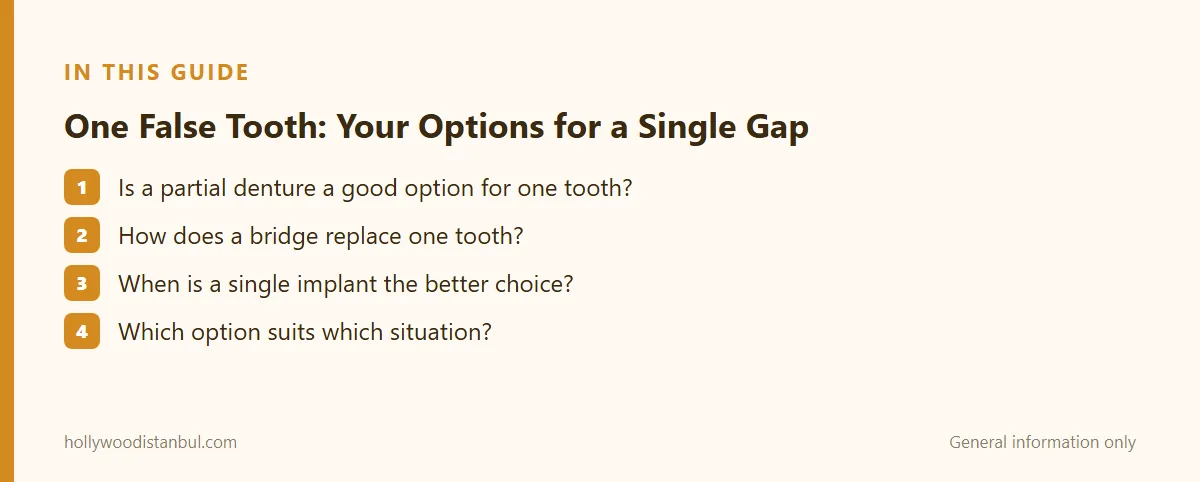
Is a partial denture a good option for one tooth?
The Australian Dental Association (ADA) says partial dentures replace one or more missing teeth, sit on the gums and clip onto remaining teeth, and can be made of plastic or cobalt chrome with plastic. The Better Health Channel (Victorian Government) notes dentures are usually more affordable than other tooth replacement options.
- Pros: removable, usually lower cost, no surgery.
- Cons: clasps grip the neighbouring teeth, the denture comes out at night, and Better Health says relines or remakes may be needed as your gums and bone change.
How does a bridge replace one tooth?
The ADA explains that a bridge usually joins crowns on the teeth either side of the gap to a false tooth in the middle. The neighbouring teeth are reshaped at the first visit and the lab-made bridge is cemented at the second, with a temporary bridge in between. Cleveland Clinic adds that a resin-bonded (Maryland) bridge, with metal wings bonded to the backs of neighbouring teeth, is typically used for front teeth, and that bridges typically last 5 to 15 years.
- Pros: fixed in place, no surgery.
- Cons: healthy neighbouring teeth are usually reshaped, and the ADA notes ordinary floss cannot pass between joined crowns, so you will need floss threaders, superfloss or interdental brushes.
When is a single implant the better choice?
Cleveland Clinic describes a single implant as a post placed in the jawbone that supports a crown. Healing, as the bone fuses to the implant, takes about three to nine months. With good care the implant itself can often last a lifetime, while crowns typically last around 15 years. Untreated gum disease, severe bone loss, unmanaged diabetes and smoking can make implants less suitable.
- Pros: does not rely on neighbouring teeth, fixed, long-lasting.
- Cons: surgery, months of healing, and you need healthy gums and enough bone.
See dental bridges versus implants in Australia for a closer comparison.
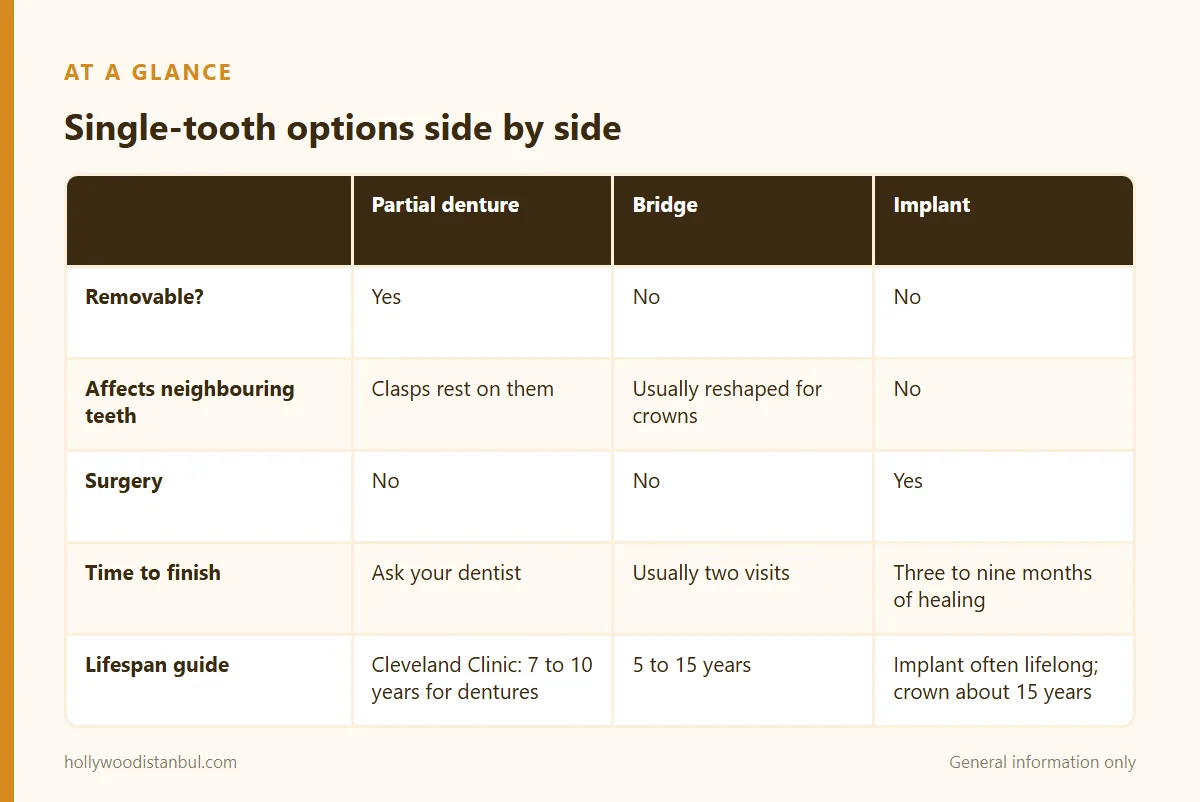
Single-tooth options side by side
| Partial denture | Bridge | Implant | |
|---|---|---|---|
| Removable? | Yes | No | No |
| Affects neighbouring teeth | Clasps rest on them | Usually reshaped for crowns | No |
| Surgery | No | No | Yes |
| Time to finish | Ask your dentist | Usually two visits | Three to nine months of healing |
| Lifespan guide | Cleveland Clinic: 7 to 10 years for dentures | 5 to 15 years | Implant often lifelong; crown about 15 years |
Which option suits which situation?
- Young people still growing: Cleveland Clinic notes most dentists do not place bridges before about 17 or 18, and a temporary partial denture (a “flipper”) may work better.
- Neighbouring teeth already need crowns: a bridge is worth discussing, since those teeth would be restored anyway.
- Healthy neighbours and good bone: an implant avoids cutting healthy teeth.
- Tight budget: dentures are usually the most affordable, per Better Health.
Questions to ask your dentist
- Is there enough bone for an implant, or would I need a graft?
- Are the teeth beside the gap healthy enough to support a bridge?
- Would a resin-bonded bridge suit a front tooth gap?
- What will each option cost in total, including reviews?
For pricing context, our guide to dental bridge cost in Australia sets out typical fees.
Sources
- Australian Dental Association, Dentures
- Australian Dental Association, Crowns, Bridges and Veneers
- Better Health Channel (Victorian Government), Dentures
- Cleveland Clinic, Dental Bridges
- Cleveland Clinic, Dental Implants
This article is general information and is not a substitute for advice from your own dentist.