Partial Dentures: How They Fit, Feel and Last
How partial dentures stay in, what they are made of, who makes them and how to look after them.
Editorially reviewed. Dental review: scheduled, not yet completed for this article.

Partial dentures are removable appliances that replace one or more missing teeth while your natural teeth stay in place. They sit on the gums and usually grip neighbouring teeth with small clasps, and they are made from plastic, a light cobalt chrome metal, or a combination of both.
If you have lost a few teeth but still have healthy ones left, a partial denture is one of the more straightforward ways to fill the gaps. The Australian Dental Association describes dentures as a cost-effective option for replacing one or more missing teeth, and notes they can be permanent or temporary and suit people of all ages. This guide covers how partials hold on, what they are made of, who makes them in Australia, and what the first few weeks of wearing one are actually like.
How do partial dentures stay in place?
A full denture relies on suction and the shape of the gums. A partial has an extra anchor: the teeth you still have. The Victorian Government’s Better Health Channel explains that partial dentures usually have little metal clasps that rest or grip on the natural teeth to hold the denture in place. Cleveland Clinic adds that partials are also supported by the gums and underlying bone, with the clasps hooking around remaining teeth for extra stability.
That reliance on your own teeth has a practical consequence. Better Health stresses that your remaining teeth and gums need to be in good health to support the partial denture. If the anchor teeth have untreated decay or gum disease, your dentist will usually want to deal with that first.
Plastic or cobalt chrome: what are the options?
The ADA says the body of a partial denture may be made from plastic, or from a thin, light metal called cobalt chrome. Your dentist or prosthetist will talk through the options when planning the appliance. In broad terms:
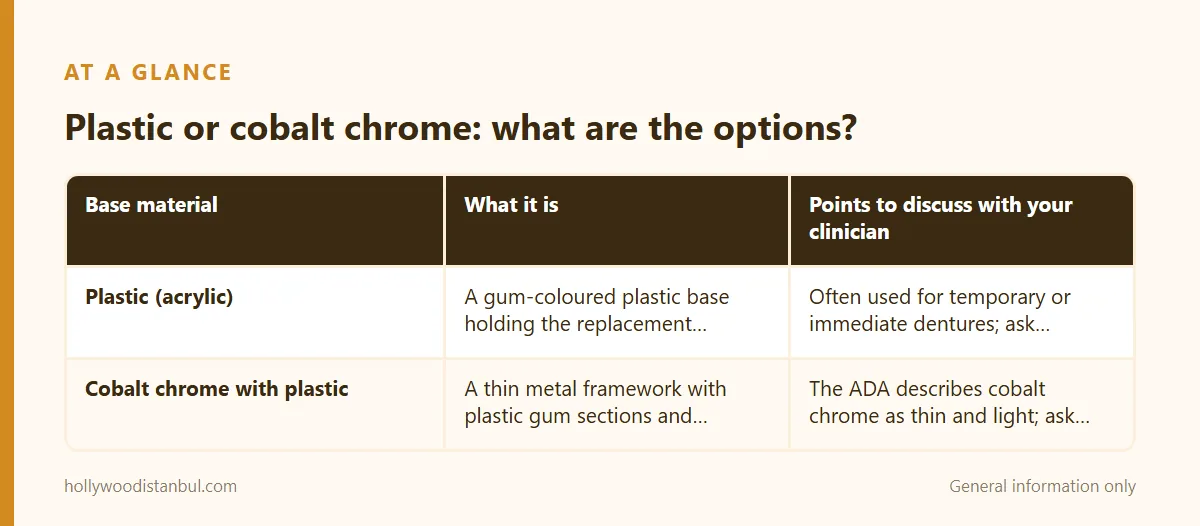
| Base material | What it is | Points to discuss with your clinician |
|---|---|---|
| Plastic (acrylic) | A gum-coloured plastic base holding the replacement teeth | Often used for temporary or immediate dentures; ask how thick the base will be and how it will feel |
| Cobalt chrome with plastic | A thin metal framework with plastic gum sections and teeth | The ADA describes cobalt chrome as thin and light; ask where clasps will sit and whether they will show when you smile |
Whatever the base, the teeth can be matched to the colour and shape of your natural teeth, according to the ADA.
Who makes partial dentures in Australia?
You have more than one type of practitioner to choose from. Better Health lists a dentist, a dental prosthetist (an advanced dental technician) or a specialist prosthodontist as people who can make dentures. Several visits are usually needed to check measurements and fit. The ADA notes that the number of appointments depends on how many teeth are being replaced, whether you have worn dentures before, and whether any teeth need to be removed first.
Cleveland Clinic outlines the typical sequence: an examination and X-rays, impressions of the mouth, a model made in a dental laboratory, wax set-ups to position the teeth, and a final fitting where the clinician checks for pressure points. It notes that it usually takes several visits to achieve the fit you want.
If teeth are being extracted, timing matters. Better Health says measurements usually start two to three months after extractions so the gums and bone can heal, although an immediate denture can be made so it is ready on the day the teeth come out. Immediate dentures may loosen as the bone changes and may need relining within a few months.
What is it like getting used to a partial denture?
Expect an adjustment period rather than an instant fit. Cleveland Clinic says getting used to dentures can take weeks or sometimes months, and that several adjustments may be needed in the first couple of weeks. Practical tips from Better Health:
- Start with soft foods, eat slowly, and cut food into small pieces.
- If pressure causes a sore spot, go back to your clinic as soon as possible for an adjustment rather than putting up with it.
- Speech may sound slightly different at first, and dentures can click. This usually settles with practice.
- If difficulties have not improved after a few weeks, see your dental practitioner.
How should you clean and store a partial denture?
Because a partial sits against natural teeth, cleaning both the appliance and your own teeth matters. Based on guidance from the ADA and Better Health:
- Clean the denture morning and night with a denture brush and mild soap and water or a denture cleaning solution. The ADA advises against toothpaste, which is too abrasive for plastic.
- Clean over a towel or a half-filled basin so a dropped denture is less likely to break.
- Rinse in cold water. Better Health warns that hot water can change the shape and fit.
- Brush your remaining teeth with a soft brush and fluoride toothpaste, and gently brush your gums and the roof of your mouth.
- Take the denture out before sleep and store it clean and dry. Better Health says this gives your mouth a chance to rest and helps prevent fungal infections.
How long do partial dentures last?
Your mouth keeps changing after tooth loss, so even a well-made partial will not fit forever. Cleveland Clinic gives an average lifespan for dentures of seven to 10 years and suggests a reline every one to two years, or sooner if the fit changes. The ADA recommends keeping up regular check-ups, both because dentures may need relining or replacing and because dentists check for conditions such as oral thrush and oral cancer at those visits.
Book an earlier visit if you notice pain, ulcers that last more than two weeks, a loose or uncomfortable fit, bleeding gums, or cracks at the corners of your mouth, all of which Better Health lists as reasons to see your practitioner.
Partial dentures are not the only way to replace missing teeth. If you are weighing up alternatives, our comparisons of dental implants and dentures in Australia and bridges and implants set out the trade-offs.
Sources
- Better Health Channel (Victorian Government), Dentures
- Australian Dental Association, Dentures
- Cleveland Clinic, Dentures: Types, Procedure & Care
This article is general information and is not a substitute for advice from your own dentist.