How Do Dentures Work? Fit, Function and Changes Over Time
What holds a full denture in place, how it is made and why the fit changes over time.
Editorially reviewed. Dental review: scheduled, not yet completed for this article.

How do dentures work? A full denture is a custom-made plastic base with artificial teeth that rests on your gums and is supported by the bone beneath them, custom-fitted to your mouth. Partial dentures also clip onto remaining teeth, and implant-retained dentures attach to implants in the jaw.
Understanding the mechanics explains a lot about life with dentures: why the first weeks feel strange, why the fit changes over the years, and why some people find adhesive or implants helpful. This guide focuses on full (complete) dentures for people missing all the teeth in a jaw.
What holds a full denture in place?
Cleveland Clinic explains that dentures rely on the gums and underlying bone for support. Better Health stresses that dentures should be well fitted and comfortable. The Victorian Government’s Better Health Channel notes full dentures are made from plastic and are used when all the teeth in one jaw are missing.
Unlike a partial, a full denture has no natural teeth to clip on to. Better Health says denture adhesive can help, especially if your bone is thin, and the Australian Dental Association also mentions adhesive as an option if a denture does not stay in place well.
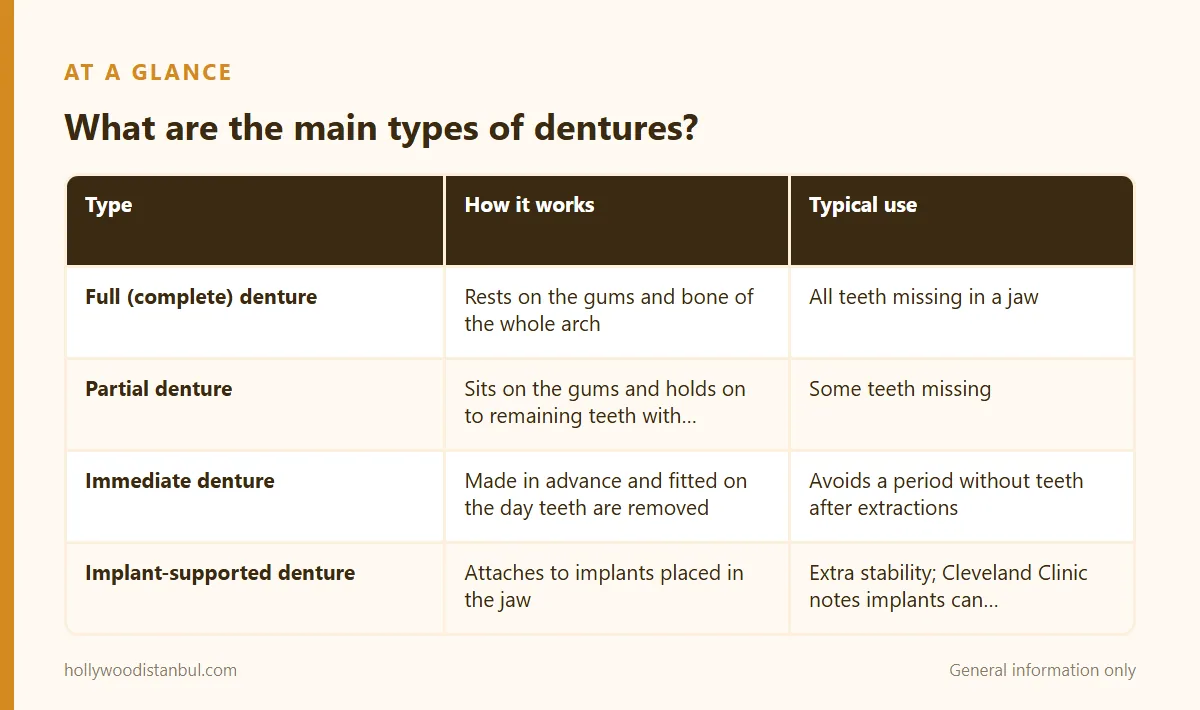
What are the main types of dentures?
| Type | How it works | Typical use |
|---|---|---|
| Full (complete) denture | Rests on the gums and bone of the whole arch | All teeth missing in a jaw |
| Partial denture | Sits on the gums and holds on to remaining teeth with clasps | Some teeth missing |
| Immediate denture | Made in advance and fitted on the day teeth are removed | Avoids a period without teeth after extractions |
| Implant-supported denture | Attaches to implants placed in the jaw | Extra stability; Cleveland Clinic notes implants can stabilise loose dentures |
How are dentures made?
Cleveland Clinic describes the usual steps: an examination and X-rays, impressions of your mouth, a stone model made by a laboratory, wax set-ups to position the teeth, and a fitting appointment where the clinician checks for pressure points. It usually takes several visits to achieve the right fit. In Australia, Better Health notes dentures can be made by a dentist, a dental prosthetist (an advanced dental technician) or a specialist prosthodontist.
If teeth are being removed, Better Health says measurements usually start two to three months later so the gums and bone can heal. An immediate denture avoids going without teeth, but may loosen as the bone changes and need relining within a few months.
Why does eating and speaking feel different at first?
Cleveland Clinic says adjusting can take weeks or sometimes months, and that dentures may shift or slip when speaking or chewing. Better Health suggests:
- starting with soft food, eating slowly and cutting food into small pieces
- returning to the clinic promptly for adjustment if a sore spot develops
- expecting speech to sound a little different, and possible clicking, at first
- seeing your practitioner if difficulties have not improved after a few weeks
Why does the fit change over time?
After teeth are lost, the jawbone gradually shrinks. Cleveland Clinic notes this bone loss can eventually lead to a sunken look in the cheeks, while implants can help preserve jawbone. As the ridge changes, a denture that fitted well can become loose. Cleveland Clinic suggests a reline every one to two years, or sooner if the fit changes, and gives an average denture lifespan of seven to 10 years.
How do you care for full dentures?
- Brush dentures morning and night with a denture brush and mild soap, not toothpaste, which the ADA says is too abrasive.
- Rinse in cold water, never hot, which Better Health warns can warp them.
- Take them out overnight and store them clean and dry.
- Gently brush your gums and the roof of your mouth.
- Keep regular check-ups so your dentist can check the fit and the health of your mouth.
For a comparison of dentures with fixed options, see our guides to implants versus dentures in Australia and All-on-4 implants.
Sources
- Better Health Channel (Victorian Government), Dentures
- Australian Dental Association, Dentures
- Cleveland Clinic, Dentures
- Cleveland Clinic, Dental Implants
This article is general information and is not a substitute for advice from your own dentist.