Dental Crown Procedure: Two Visits, Step by Step
What happens at each crown appointment, same-day options and recovery.
Editorially reviewed. Dental review: scheduled, not yet completed for this article.

The dental crown procedure usually takes two appointments: at the first, the dentist reshapes the tooth, takes an impression or digital scan and fits a temporary crown; at the second, the custom crown made by a dental technician is cemented in place. Some practices can make a ceramic crown on the same day.
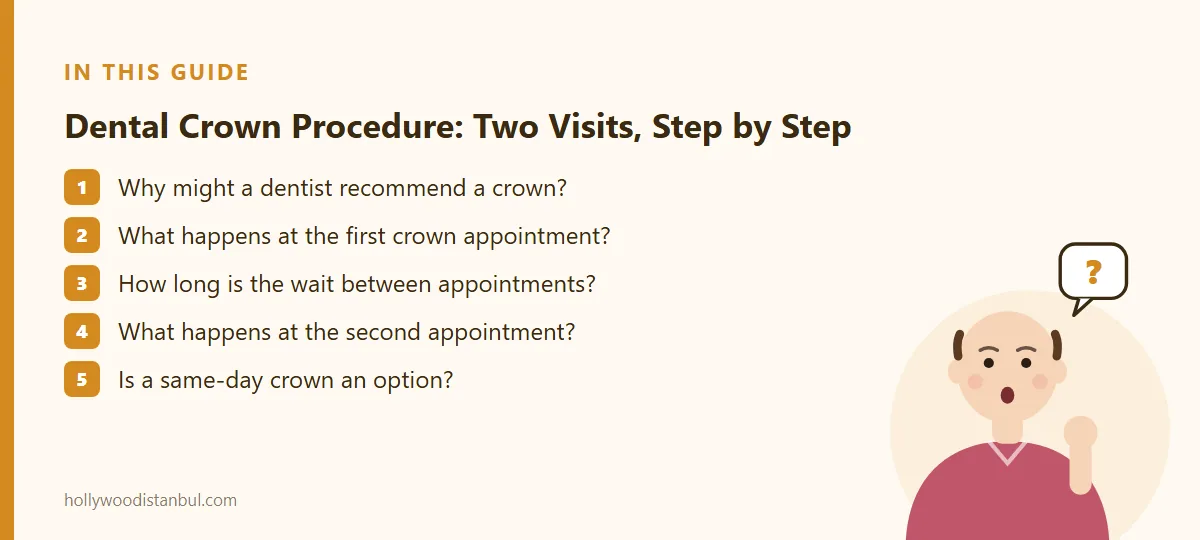
Knowing the sequence ahead of time makes it easier to plan time off work, understand why you leave the first visit with a temporary tooth, and recognise what is normal in the days afterwards. Here is how the process typically runs in an Australian practice, based on guidance from the Australian Dental Association and Cleveland Clinic.
Why might a dentist recommend a crown?
The ADA says a crown may be recommended to fix a badly broken, cracked or decayed tooth, and crowns are often used on premolars and molars after root canal treatment. A crown fits over the natural tooth after it has been cut back, covering it completely. Cleveland Clinic likens it to a snug hat over the whole tooth.
Crowns can be made from porcelain, zirconia or gold alloy, the ADA notes, and both general dentists and prosthodontists provide them. Our guide to the types of dental crowns in Australia compares materials in more depth.
What happens at the first crown appointment?
- Preparing the tooth. The dentist removes some of the outer tooth to make room for the crown. Cleveland Clinic says weak areas may be built up with filling material at this stage. The procedure should not be painful, and if you feel discomfort you can ask for more anaesthetic.
- Recording the shape. An impression is taken with a putty-like material, or the ADA notes a digital scanner may be used to take a 3D image of the tooth.
- Fitting a temporary crown. A temporary crown, usually resin or acrylic according to Cleveland Clinic, protects the prepared tooth while the final crown is made.
How long is the wait between appointments?
The impression or scan goes to a dental technician. Cleveland Clinic says it usually takes two to three weeks, sometimes longer, for the laboratory to make the final crown. During that time, be gentle with the temporary crown: Cleveland Clinic advises avoiding the same foods that can damage permanent crowns, such as ice, very hard nuts, popcorn kernels and sticky lollies like caramels, which can dislodge a crown.
What happens at the second appointment?
The dentist removes the temporary crown, checks the new crown’s shape, colour and fit before fixing it. The ADA describes the new crown being glued or cemented onto the natural tooth structure, and Cleveland Clinic refers to bonding with strong dental cement.
Is a same-day crown an option?
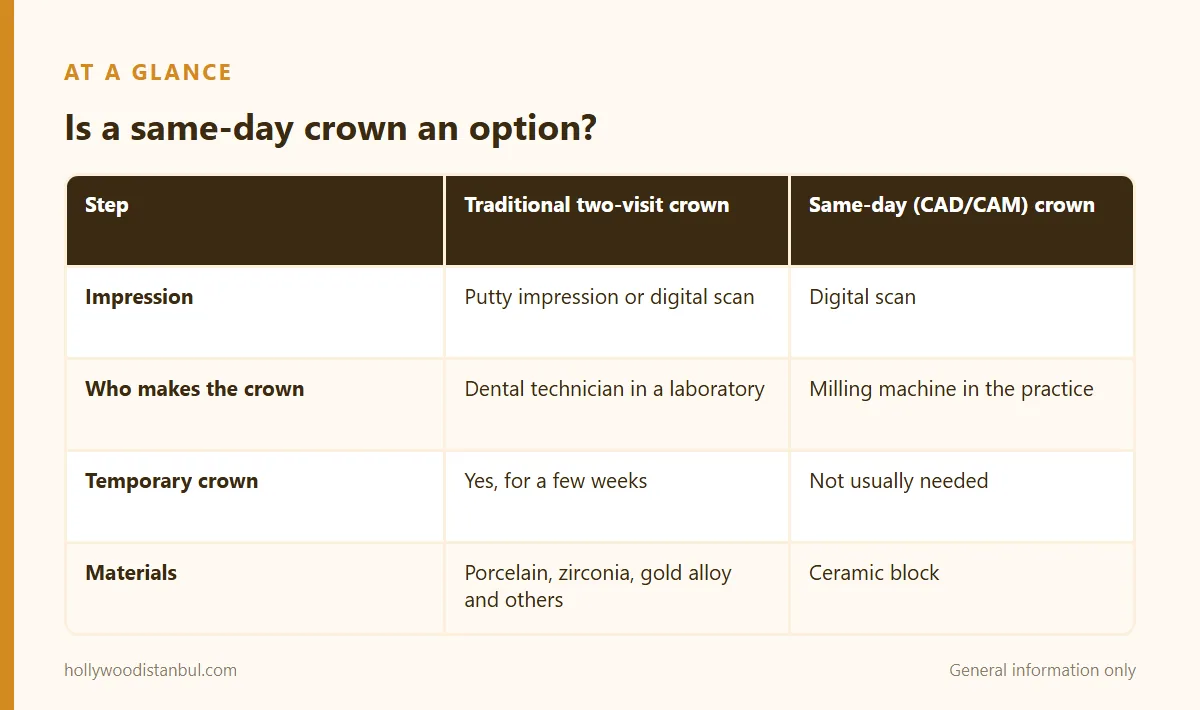
Some dentists offer same-day crowns, the ADA notes. Cleveland Clinic explains how this works: digital impressions are used to design the crown, which is then milled from a solid block of ceramic by an on-site machine, so the whole crown can be done in one visit. Not everyone is a candidate, and your dentist can tell you whether your tooth and the material required suit this approach.
| Step | Traditional two-visit crown | Same-day (CAD/CAM) crown |
|---|---|---|
| Impression | Putty impression or digital scan | Digital scan |
| Who makes the crown | Dental technician in a laboratory | Milling machine in the practice |
| Temporary crown | Yes, for a few weeks | Not usually needed |
| Materials | Porcelain, zirconia, gold alloy and others | Ceramic block |
What is recovery like after a crown?
Cleveland Clinic says most people return to work and normal activities straight away. Sensitivity, especially to heat and cold, is normal for a few weeks, and gum tenderness should fade within a few days. Over-the-counter pain relief can help. If pain gets worse rather than better, or the crown feels loose, contact your dentist.
What if a tooth is missing rather than damaged?
When a tooth has been lost, crowns can be joined together to form a bridge. The Australian Dental Association explains that a bridge replaces one or more missing teeth and is made from the same materials as crowns, and that partial dentures and dental implants are the main alternatives. Because the crowns in a bridge are joined, ordinary floss cannot pass between them; the ADA suggests cleaning underneath with superfloss, floss threaders or interdental brushes. Our guide to dental bridges vs implants in Australia compares the options.
How do you care for a crown long term?
- Brush twice daily with fluoride toothpaste and clean between your teeth every day, as the ADA recommends for crowns and bridges.
- Avoid using crowned teeth on ice, hard nuts and very sticky foods.
- Keep regular check-ups. The ADA points out that crowned teeth can still develop decay, and crowns can chip, fracture or stop matching the colour of nearby teeth and need replacing.
Cleveland Clinic gives an average crown lifespan of five to 15 years with proper care. For costs, see our dental crown cost breakdown for Australia.
Sources
- Australian Dental Association, Crowns, Bridges and Veneers
- Cleveland Clinic, Dental Crowns
This article is general information and is not a substitute for advice from your own dentist.