Upper Partial Teeth: Types, Fitting and Daily Care
An upper partial denture replaces missing top teeth and clips onto the teeth you still have; here's how the main types compare and how to care for one.
Editorially reviewed.
Upper partial teeth are removable partial dentures that replace one or more missing teeth in the top jaw, resting on the gums and clipping onto your remaining natural teeth for stability. They are usually made from acrylic (plastic), a cobalt-chrome metal framework, or a flexible nylon-based material.
A partial denture is one of several ways to fill gaps when some natural teeth remain. Bridges and implants are the other common options, and the right choice depends on how many teeth are missing, the health of the teeth that are left, your jawbone and your preferences. This guide explains how upper partials are made, how the main materials differ, what the first weeks feel like and how to care for one.
How an upper partial denture works
The Australian Dental Association describes a partial denture as one that rests on the gums and clips onto your remaining teeth. Cleveland Clinic explains that partials rely on the gums and underlying bone for support, like full dentures, but also use clasps that hook around natural teeth to add stability. Artificial teeth are set into a base, and those teeth can be matched to the colour and shape of your own.
Because the denture is removable, you take it out to clean it and usually overnight. That’s a key difference from a bridge, which is fixed to neighbouring teeth, or an implant, which is placed in the jawbone. Our article on dental implants vs dentures compares those routes.
Types of upper partials
The ADA notes that the body of a partial denture may be plastic or cobalt chrome, a thin, light metal, and that your dentist will discuss the options. Flexible partials made from thermoplastic nylon are a third choice in some situations.
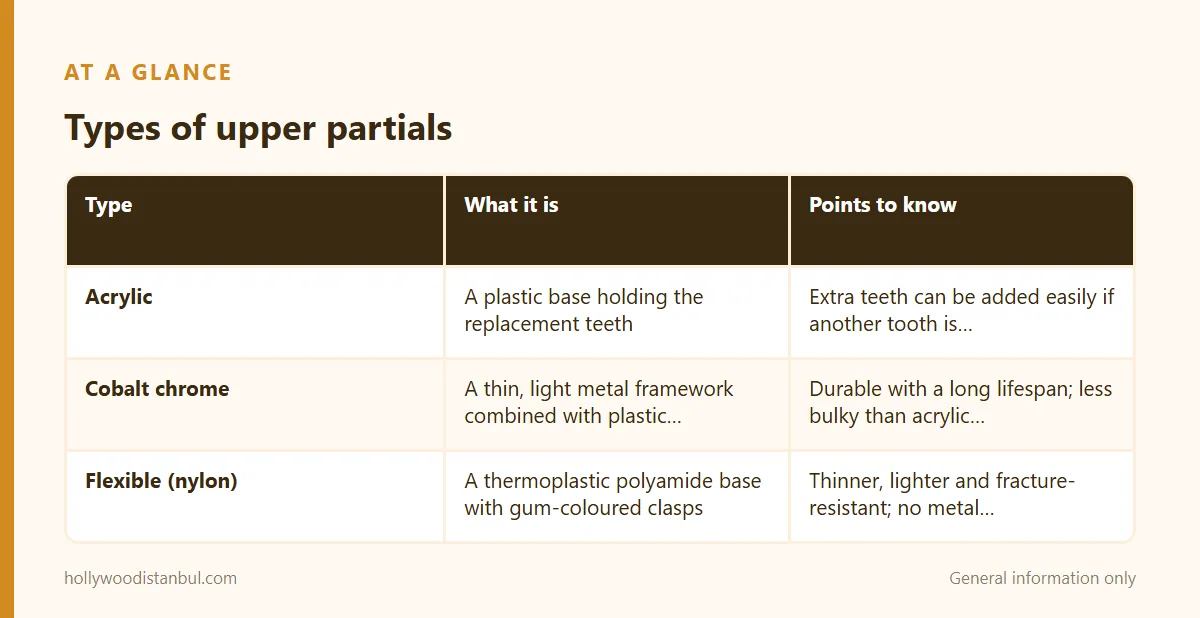
| Type | What it is | Points to know |
|---|---|---|
| Acrylic | A plastic base holding the replacement teeth | Extra teeth can be added easily if another tooth is lost later; can be made and fitted on the day of an extraction |
| Cobalt chrome | A thin, light metal framework combined with plastic and artificial teeth | Durable with a long lifespan; less bulky than acrylic; clips onto remaining teeth; may not suit everyone |
| Flexible (nylon) | A thermoplastic polyamide base with gum-coloured clasps | Thinner, lighter and fracture-resistant; no metal visible; harder to repair or reline and can stain over time |
Details on acrylic and cobalt chrome come from Australian health fund Westfund’s denture guide, which also describes flexible thermoplastic dentures as useful for restoring small gaps. A 2024 literature review in Cureus found flexible bases suit people with metal or acrylic allergies, restricted mouth opening, or those who want to hide metal clasps at the front, but concluded that conventional acrylic (PMMA) remains the standard base material for most cases.
Getting an upper partial fitted
Partials are custom-made by a dentist or a dental prosthetist. According to the ADA, a dentist measures and fits you at the clinic and sends the work to a laboratory, whereas a prosthetist builds the denture themselves between appointments. Several visits are usually needed.
- Assessment. Cleveland Clinic says your dentist examines your gums, remaining teeth and jawbone, often with X-rays.
- Impressions. Often a preliminary and a final impression, used to make a stone model of your mouth.
- Bite and try-in. Wax blocks help position the teeth, and a try-in lets the dentist check fit and appearance before the denture is finished.
- Fitting. The dentist checks for pressure points and makes final adjustments.
If teeth need removing first, the ADA notes a dentist may suggest waiting a few months for the gums and bone to heal. An immediate denture can be fitted on the day of extraction, but it may need more follow-up visits and earlier replacement.
The first few weeks
The ADA compares a new denture to new shoes: it can feel uncomfortable at first, and small adjustments are common. It can take a few weeks to get used to dentures. Practising putting them in and taking them out, and eating softer foods until you’re comfortable, can help. Cleveland Clinic notes that adjusting can take weeks or sometimes months, with several adjustments in the first couple of weeks.
See your dentist or prosthetist if your partial clicks when you talk, slips, causes pain, pinches your gums or no longer fits well. Our guide to how partial dentures fit, feel and last covers this adjustment period in more depth.
Daily care
- Take the partial out and clean it every morning and night. The ADA suggests a spare toothbrush or denture brush with liquid hand soap; mild soap or washing-up liquid can also be used.
- Avoid toothpaste on the denture, as it’s too abrasive for plastic.
- Clean it over a towel or a bowl or sink of water, since a dropped denture can break.
- Rinse it after meals to remove loose food.
- Brush your gums, tongue and remaining natural teeth with fluoride toothpaste.
- Remove it at night unless your dentist advises otherwise. Wearing dentures overnight raises the risk of gum infections and decay, and of choking.
A denture-cleaning soak helps remove bacteria. The ADA notes that a soak in white vinegar diluted 1:4 overnight can loosen hard tartar deposits before normal cleaning.
Check-ups and lifespan
Your mouth changes shape over time, so a partial that once fitted well can loosen. The ADA recommends regular visits even if you wear dentures, so your dentist can check the fit and look at the soft tissues for signs of oral cancer or thrush. Cleveland Clinic suggests a reline every one to two years, or sooner if the fit changes, and gives an average denture lifespan of seven to 10 years.
Frequently asked questions
Do upper partials cover the roof of the mouth?
Design varies with the material and which teeth are missing. Your dentist or prosthetist will explain how much of the palate your partial needs to cover.
Can I add a tooth to my partial later?
With acrylic partials, extra teeth can usually be added if another natural tooth is lost. Other designs may be less adaptable, so ask when choosing a material.
Can I use denture adhesive with a partial?
Yes, if it helps. The ADA says adhesive can help a denture that doesn’t stay in place, but a poor fit is still worth having checked.
Sources
- Australian Dental Association (teeth.org.au), Dentures
- Cleveland Clinic, What Are Dentures? Types, Care & Benefits
- NHS, Dentures (false teeth)
- Westfund Health Insurance, Dentures
- Binaljadm T.M., Cureus (PubMed Central), Flexible Denture: A Literature Review
This article is general information and doesn’t replace advice from your own dentist.