Bridge for Teeth: How Dental Bridges Work
How dental bridges work, the four main types, who they suit and how to clean under one.
Editorially reviewed.

A bridge for teeth replaces one or more missing teeth with a false tooth held in place by crowns on the neighbouring teeth, or by implants. It is fixed, so you don’t take it out, and it is usually made over two visits with a temporary bridge in between.
Bridges are one of the longest-standing ways to fill a gap in your smile. They suit some situations very well and others less so, depending on the teeth around the gap. This explainer covers how a bridge works, the main types, what treatment involves and how to look after one.
How does a dental bridge work?
The Australian Dental Association (ADA) explains that a bridge usually consists of crowns on the teeth either side of the gap, joined to a false tooth that sits in the space. At the first visit the neighbouring teeth are reshaped; the bridge is made in a dental laboratory and cemented at the second visit, with a temporary acrylic bridge protecting the teeth in the meantime. Bridges can be made from the same materials as crowns: porcelain, zirconia, gold alloy or porcelain fused to metal.
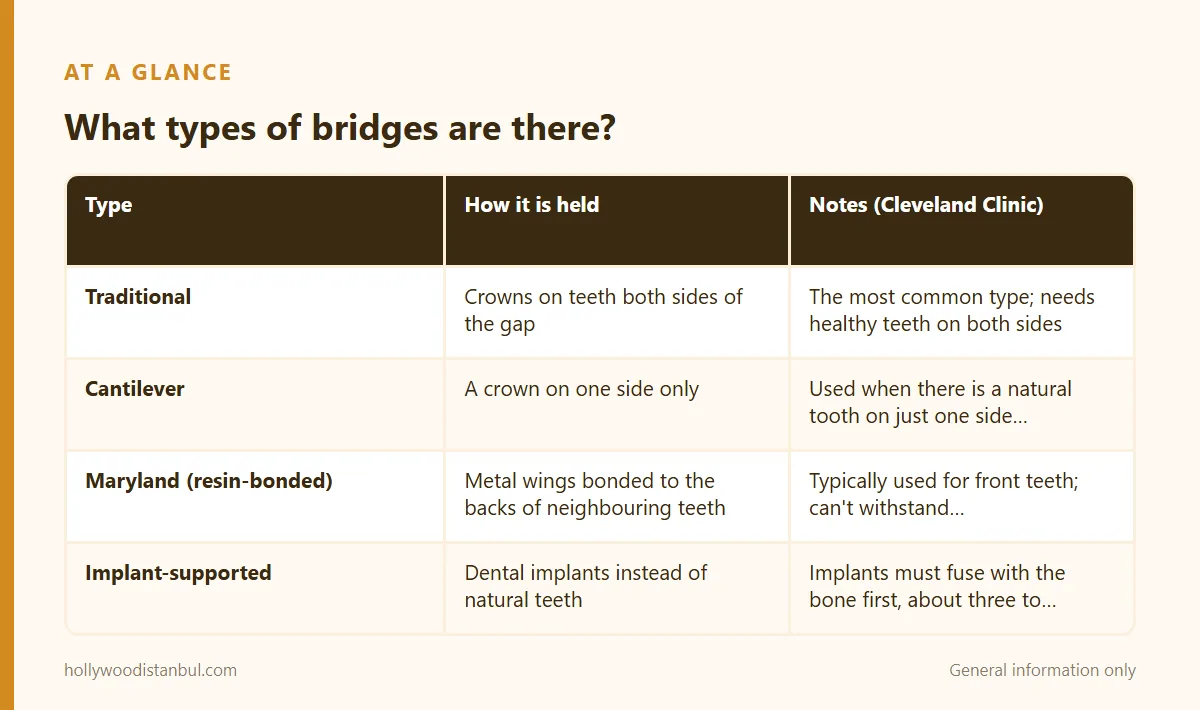
What types of bridges are there?
| Type | How it is held | Notes (Cleveland Clinic) |
|---|---|---|
| Traditional | Crowns on teeth both sides of the gap | The most common type; needs healthy teeth on both sides |
| Cantilever | A crown on one side only | Used when there is a natural tooth on just one side; less strong |
| Maryland (resin-bonded) | Metal wings bonded to the backs of neighbouring teeth | Typically used for front teeth; can’t withstand back-tooth chewing forces |
| Implant-supported | Dental implants instead of natural teeth | Implants must fuse with the bone first, about three to six months on average |
Who is a bridge suitable for?
A traditional bridge needs healthy teeth on both sides of the gap. Cleveland Clinic notes most dentists do not place bridges in people younger than about 17 or 18, because the jaw is still developing. The ADA lists partial dentures and dental implants as the alternatives, each with different benefits. Cleveland Clinic adds that bridges are typically more comfortable than partial dentures and more affordable than implants. Compare the options in dental bridges vs implants in Australia.
What are the pros and cons of a bridge?
- Pro: fixed in place, with no clasps or removal at night.
- Pro: no surgery for a traditional bridge.
- Pro: restores chewing and appearance, according to Cleveland Clinic.
- Con: healthy neighbouring teeth are usually reshaped for crowns.
- Con: cleaning under the false tooth takes extra effort.
- Con: it will eventually need replacing; Cleveland Clinic says bridges typically last 5 to 15 years.
How do you clean under a bridge?
Because the crowns are joined, ordinary floss cannot pass between them. The ADA says your dentist will show you alternatives such as superfloss, floss threaders or interdental brushes. Brush twice a day with fluoride toothpaste and clean between your teeth every day. The ADA also stresses that teeth under crowns and bridges can still decay, so check-ups remain important.
How much does a bridge cost?
Bridge fees in Australia depend on the number of units, the material and the practice. As a reference point, CHOICE reported an average fee of $1,678 for a single veneered full crown (item 615) in the ADA’s 2022 fee survey; a bridge involves several such units. For a full breakdown, see our guide to dental bridge cost in Australia.
Questions to ask your dentist
- Are the teeth beside the gap healthy enough to support a bridge?
- Which type of bridge suits this gap, and why?
- Would an implant or partial denture be a better option for me?
- Which material do you recommend?
- How will I clean under it, and what should I expect over time?
Sources
- Australian Dental Association, Crowns, Bridges and Veneers
- Cleveland Clinic, Dental Bridges
- CHOICE, How much should you pay at the dentist? (ADA 2022 fee survey, updated 9 March 2023)
This article is general information and is not a substitute for advice from your own dentist.