Traditional Braces: How Metal and Ceramic Braces Work
Fixed metal and ceramic braces move teeth with brackets and a wire; this guide covers how they compare with aligners, what treatment involves and how to keep teeth clean.
Editorially reviewed.

Traditional braces are fixed orthodontic appliances: brackets bonded to each tooth and joined by a thin wire that gently moves teeth into a better position. They come in metal or tooth-coloured ceramic and usually stay on for one to three years.
Braces have been used for about a century, according to the Australian Dental Association, and they remain a mainstay of orthodontic treatment alongside newer options such as clear aligners. Orthodontists, who are specialist dentists, provide most of this care, though some general dentists offer certain orthodontic treatments too. This guide explains how fixed braces work, how they compare with aligners, what treatment involves and how to look after your teeth while wearing them.
What traditional braces can treat
Orthodontic treatment addresses crooked or crowded teeth, gaps, poor bite patterns and misalignment of the teeth or jaws, the ADA explains. Braces may also be suggested when tooth position makes chewing or cleaning difficult. The ADA notes treatment may also help prevent uneven tooth wear.
Braces aren’t only for teenagers. Healthdirect says orthodontists treat children, teenagers and adults. For children, the ADA recommends an orthodontic assessment between seven and 10 years of age; not every adult tooth needs to be through for this check.
The parts of fixed braces
- Brackets: small attachments bonded to each tooth that hold the wire.
- Archwire: a thin, flexible wire running across the brackets that guides tooth movement.
- Ligatures or modules: tiny elastic pieces that hold the wire in the brackets. Self-ligating braces use a built-in clip instead.
- Bands: included in some metal brace set-ups; your orthodontist will explain if yours use them.
Metal, ceramic and other options compared
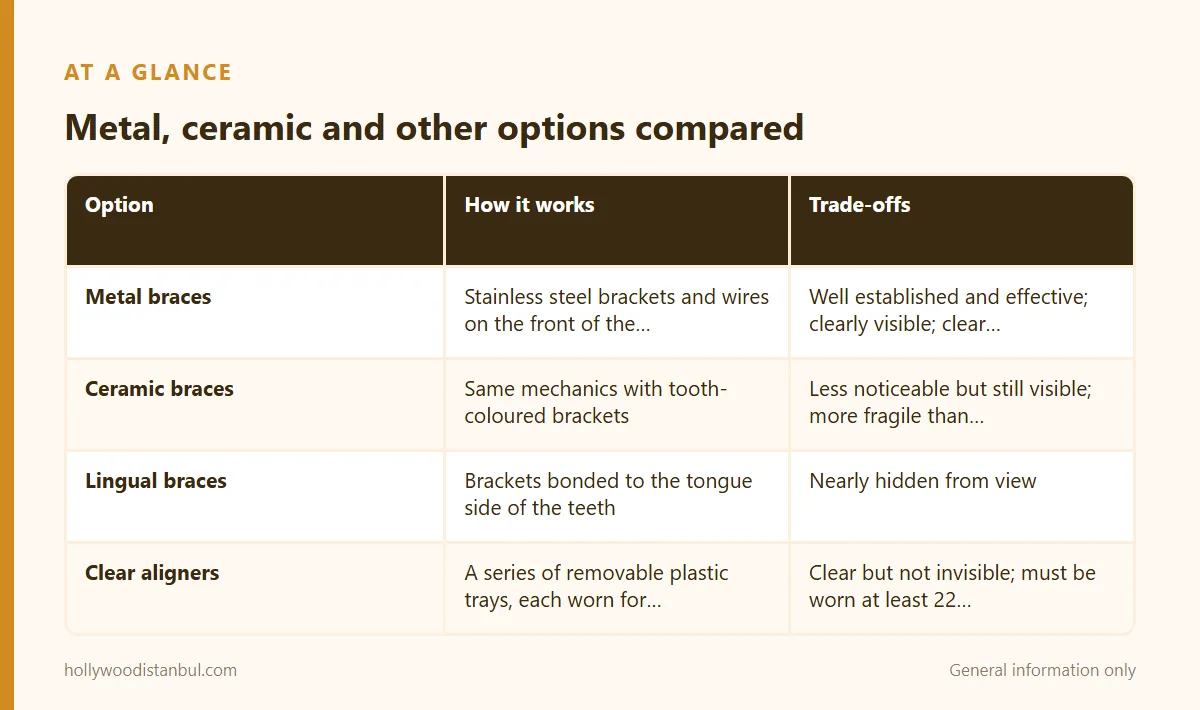
| Option | How it works | Trade-offs |
|---|---|---|
| Metal braces | Stainless steel brackets and wires on the front of the teeth | Well established and effective; clearly visible; clear or coloured elastics available |
| Ceramic braces | Same mechanics with tooth-coloured brackets | Less noticeable but still visible; more fragile than metal |
| Lingual braces | Brackets bonded to the tongue side of the teeth | Nearly hidden from view |
| Clear aligners | A series of removable plastic trays, each worn for about two weeks | Clear but not invisible; must be worn at least 22 hours a day; severe cases may need fixed braces |
The main practical difference is control over wear time. Fixed braces work around the clock because you can’t take them out. Aligners rely on you wearing them almost all the time, removing them only to eat, brush and drink anything other than water. The ADA warns that sugary or acidic drinks trapped under aligners can damage teeth if it happens often. A dentist or orthodontist can tell you which approach suits your situation.
What treatment involves
- Assessment. Healthdirect describes an examination of your mouth and face, possibly with X-rays and plaster or digital models of your teeth, followed by a discussion of a treatment plan.
- Fitting. Brackets are glued to each tooth, a wire connects them, and small elastic modules hold the wire in place. Let your orthodontist know if a front tooth has ever been knocked or damaged.
- Adjustments. Regular appointments, usually every six to eight weeks, let the orthodontist adjust the wire. Healthdirect says check-ups typically last 30 to 60 minutes.
- Removal and retention. When the teeth are in position, the braces come off and a retainer is fitted.
Healthdirect puts treatment at about one to three years, and Cleveland Clinic gives an average of about two years, depending on how complex the problem is.
Discomfort and eating
Teeth may feel strange and sore for a few days after the braces go on, and tenderness can return after each adjustment. Soft foods and pain relief may help in those first days. Healthdirect notes early side effects can include mild toothache, scratches and mouth ulcers, and Cleveland Clinic suggests orthodontic wax over any bracket or wire that rubs.
Throughout treatment, hard, crunchy and sticky foods can break brackets or wires, so it’s best to avoid them, cut food into smaller pieces and skip chewing gum. Limiting sugary food and drink matters too, because decay risk rises when food lodges around brackets. If you’re anxious about how uncomfortable orthodontic work feels, our overview of pain levels in dental procedures may help.
Cleaning around braces
Healthdirect warns that poor care during treatment can leave white spots on teeth or lead to decay. The ADA’s brushing routine for braces:
- brush after every meal, since food can lodge around brackets
- use a pea-sized amount of fluoride toothpaste
- angle the brush at about 45 degrees to the gumline, then clean the tops and bottoms of each bracket
- spit out excess toothpaste without rinsing, so fluoride stays on the teeth longer
- use floss threaders or interdental brushes to clean between teeth and under the wire
Keep up regular dental check-ups alongside your orthodontic visits. Contact your orthodontist if pain lasts more than a few days after fitting or adjustment, if your gums are very red or swollen, or if a bracket or wire breaks.
Retainers after braces
Teeth tend to drift back towards their old positions, so a retainer is needed after braces come off. Healthdirect says some people wear a retainer only at night and others all the time; your orthodontist decides how long and how often.
Frequently asked questions
Do I need a referral to see an orthodontist?
Healthdirect says you don’t need a referral to see a private orthodontist, though public treatment may require one.
Are DIY or mail-order aligners a substitute for braces?
The ADA doesn’t recommend do-it-yourself orthodontics, citing risks of permanent damage to teeth, gums and jaw joints. Treatment should start with an in-person assessment and continue with regular supervision.
Are ceramic braces as strong as metal ones?
They work the same way, but Cleveland Clinic notes ceramic brackets are more fragile and more likely to break.
Sources
- Australian Dental Association (teeth.org.au), Teeth straightening and braces
- healthdirect Australia, Orthodontic treatments
- NHS, Braces
- Cleveland Clinic, Braces: Types & How They Work
This article is general information and doesn’t replace advice from your own dentist.