Full Dentures: The Timeline From Fitting to Feeling Normal
What to expect with a full set of dentures, from healing and impressions to the first weeks of wear, daily care, relines and yearly check-ups.
Editorially reviewed.

Full dentures are removable plates that rest on the gums and replace all the teeth in the upper jaw, the lower jaw or both. In Australia they are custom-made by a dentist or dental prosthetist over several appointments, and they usually take a few weeks to feel normal.
If you are facing the loss of all your remaining teeth, or your current full set no longer fits, it helps to know what the process looks like from first visit to settling in. This guide walks through the timeline, the first weeks of wear, and the ongoing checks that keep a full denture comfortable.
What are full dentures made of?
The Australian Dental Association notes that full dentures are usually made of plastic (acrylic). Partial dentures, by contrast, often combine plastic with a thin, light metal called cobalt chrome. A full denture is made up of artificial teeth set into a gum-coloured base. For a closer look at the materials, see our guide to how dentures work.
A full denture stays in place by sitting on the gums. Some people choose to have a full denture anchored to implants in the jaw instead; it can still be removed, but it is held more firmly.
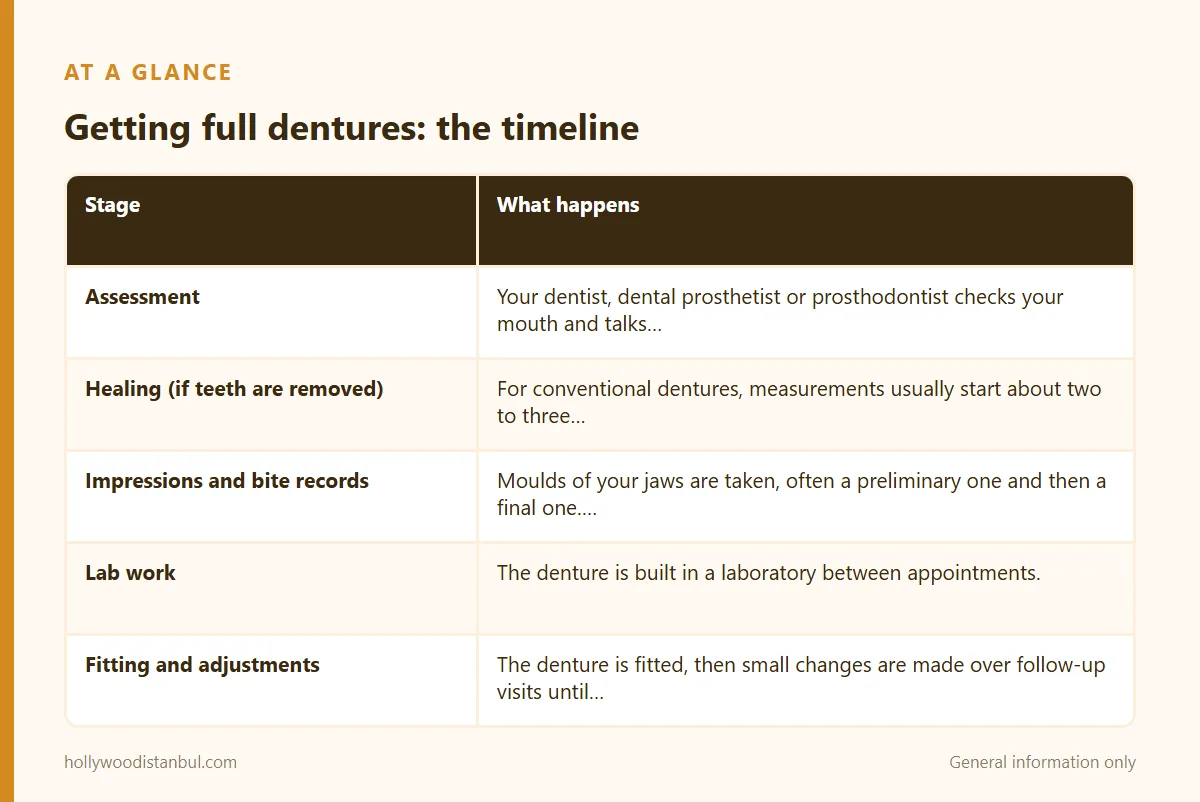
Getting full dentures: the timeline
| Stage | What happens |
|---|---|
| Assessment | Your dentist, dental prosthetist or prosthodontist checks your mouth and talks through options. |
| Healing (if teeth are removed) | For conventional dentures, measurements usually start about two to three months after teeth are taken out. |
| Impressions and bite records | Moulds of your jaws are taken, often a preliminary one and then a final one. Wax blocks help record how your jaws meet. |
| Lab work | The denture is built in a laboratory between appointments. |
| Fitting and adjustments | The denture is fitted, then small changes are made over follow-up visits until it feels comfortable. |
Making and fitting dentures often takes several appointments. If you can’t be without teeth while your gums heal, ask about immediate dentures, which are made before the teeth are removed. Better Health Channel notes they may need adjusting or relining within a few months as the gums shrink.
What are the first few weeks like?
The Australian Dental Association compares a new denture to a new pair of shoes: a little uncomfortable at first. Practical tips from Victoria’s Better Health Channel include:
- Eating: start with soft foods, eat slowly and cut food into small pieces.
- Speaking: your voice may sound different at first, and you may hear a click when you talk.
- Adhesive: denture adhesive may help, particularly if the bone under your gums is thin.
- Sore spots: your dentist or prosthetist can adjust the fit. If problems don’t settle after a few weeks, go back rather than putting up with it.
How do you look after full dentures?
- Take the denture out to clean it, and brush it morning and night with a soft brush.
- Use mild soap and water or a denture cleaning solution. Don’t use toothpaste, which is too rough for the plastic.
- Never use hot water, as it can change the shape and fit.
- Take your dentures out at night and store them as your dentist or prosthetist advises.
How long do full dentures last?
Australian sources don’t give a fixed lifespan. Better Health Channel says all dentures may need to be replaced or relined after a time, because your gums change with age, and the Australian Dental Association notes that older dentures sometimes need material added to the base to fit securely again. A US hospital source gives an average lifespan of seven to 10 years and suggests a reline every one to two years, or sooner if the fit changes.
Signs it may be time for a check include looseness, rubbing, sore spots, cracks or chips, and difficulty chewing.
Do you still need dental check-ups with full dentures?
Yes. healthdirect advises seeing your dental provider at least once a year to make sure your dentures still fit properly, and the Australian Dental Association points out that your dentist also checks the soft tissues of your mouth for signs of oral cancer. Regular visits matter even when every tooth has been replaced.
If you are weighing up full dentures against implant options, our comparison of dental implants vs dentures in Australia sets out the trade-offs.
This article is general information and is not a substitute for advice from your own dentist or dental prosthetist, who can assess your mouth and recommend what suits you.