Types of Braces: Metal, Ceramic, Lingual and Aligners
A side-by-side comparison of brace types, treatment times, retainers and how to choose with your orthodontist.
Editorially reviewed.

The main types of braces are metal braces, ceramic (tooth-coloured) braces, lingual braces fitted behind the teeth, self-ligating braces and clear aligners. All can straighten teeth; they differ in how visible they are, how much care they need and which problems they suit. Treatment usually takes one to three years.
Choosing between them is usually a conversation with an orthodontist or dentist, because the right option depends on how your teeth need to move. This guide compares the types side by side and explains what to ask in Australia.
What are the different types of braces?
Cleveland Clinic describes the main options:
- Metal braces: stainless steel bands, brackets and wires that gradually shift teeth. They are visible, but you can choose clear or tooth-coloured elastics.
- Ceramic braces: work like metal braces but use tooth-coloured parts. They are more fragile, so more likely to break.
- Lingual braces: attached to the back surfaces of the teeth, so they are hidden from view.
- Self-ligating braces: use a built-in system to hold the wire instead of elastic ties.
- Clear aligners: removable plastic trays that must be worn for at least 22 hours a day.
Healthdirect, the Australian Government health information service, adds that clear aligners are clear but not invisible.
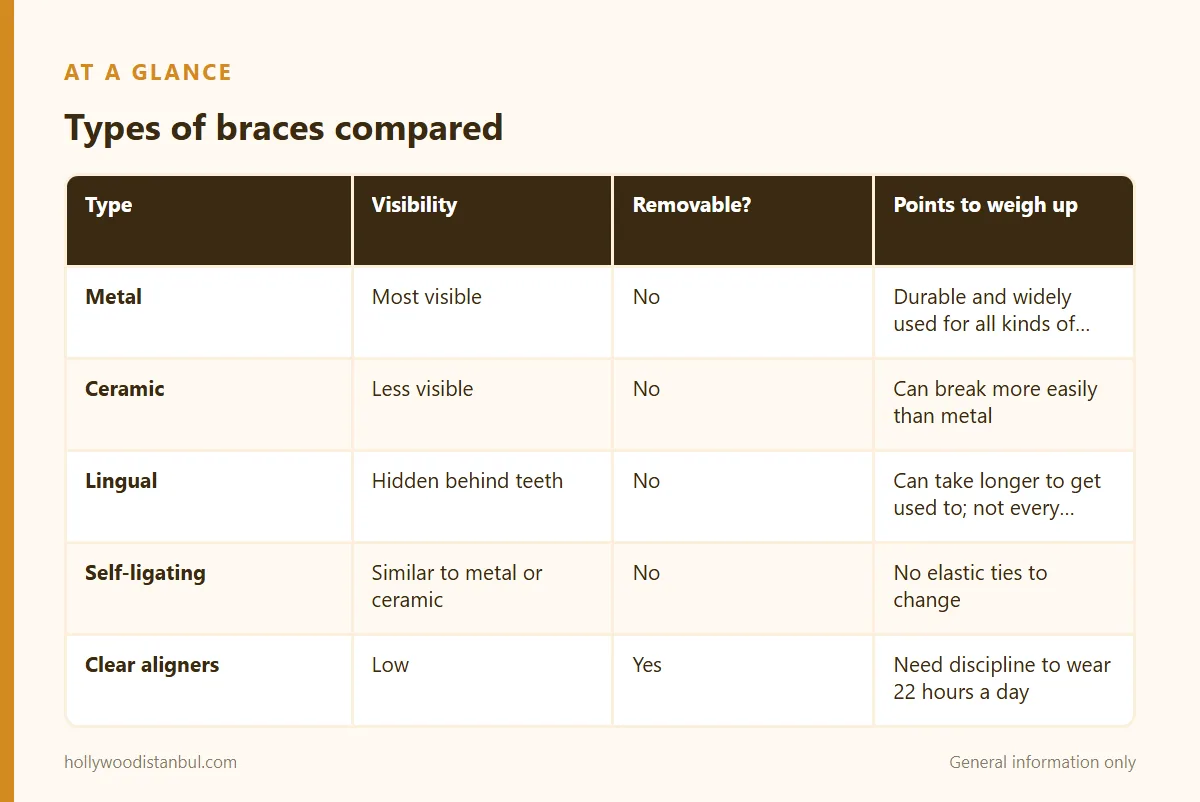
Types of braces compared
| Type | Visibility | Removable? | Points to weigh up |
|---|---|---|---|
| Metal | Most visible | No | Durable and widely used for all kinds of tooth movement |
| Ceramic | Less visible | No | Can break more easily than metal |
| Lingual | Hidden behind teeth | No | Can take longer to get used to; not every orthodontist offers them |
| Self-ligating | Similar to metal or ceramic | No | No elastic ties to change |
| Clear aligners | Low | Yes | Need discipline to wear 22 hours a day |
For more detail on fixed braces, see how metal and ceramic braces work, and for aligners, our clear aligners guide.
How long does treatment take?
Healthdirect says treatment usually takes about one to three years, with appointments of 30 to 60 minutes. Cleveland Clinic gives an average of about two years, with some people finishing in under 12 months and others needing up to three years. The type of brace matters less than the amount of movement your teeth need.
Do you need a retainer afterwards?
Yes. Cleveland Clinic says anyone who wears braces will need a retainer when treatment ends, because teeth tend to move back to their original positions. Healthdirect notes that some people only wear a retainer at night, while others wear it all the time, and that this is something to discuss with your orthodontist.
Who provides braces in Australia?
Healthdirect explains that orthodontists are specialist dentists, that many general dentists also provide some orthodontic treatment, and that you do not need a referral to see a private orthodontist. It warns that poorly done orthodontic treatment can damage teeth, gums and jaw joints, and that treatment is not suitable if your teeth and gums are unhealthy. Private health insurance may cover some of the cost, depending on your extras policy.
How to choose the right type of braces
- Ask which types are suitable for your specific bite problem, not just which look best.
- Ask how long treatment is likely to take with each option.
- Be honest about whether you would wear removable aligners for 22 hours a day.
- Get a written quote that includes retainers and follow-up visits.
- Check what your health fund will contribute.
Caring for your teeth during treatment
Cleveland Clinic recommends brushing at least twice a day with a soft brush and fluoride toothpaste, flossing daily around the braces and avoiding hard, crunchy or sticky foods. Healthdirect warns that not following the cleaning advice can lead to white spots on teeth or decay.
Frequently asked questions
Which type of braces is the fastest?
No type is reliably fastest for everyone. Treatment time depends mainly on how far your teeth need to move.
Are clear aligners as good as braces?
They can work well for many cases, but not all. Your orthodontist will advise whether aligners suit your bite.
Can adults get braces?
Yes, as long as teeth and gums are healthy. Many adults choose ceramic, lingual or aligner options.
Sources
- Cleveland Clinic, Braces
- Healthdirect Australia, Orthodontic treatments
This article is general information and doesn’t replace advice from your own dentist or orthodontist.