Gold Veneer Tooth: Gold Crowns, Grills and What’s Real
Veneers aren't made of gold, so a gold tooth usually means a gold alloy crown or a removable grill, and each comes with different trade-offs.
Editorially reviewed.

A gold veneer tooth isn’t a standard dental treatment. Veneers are made from porcelain or composite resin, so a gold look usually comes from a gold alloy crown or a removable decorative grill.
Searches for gold veneers mix two different things: dental restorations that happen to be made of gold, and jewellery worn over the teeth. The distinction matters because one is a clinical treatment that permanently changes the tooth, and the other is an accessory with its own hygiene risks. This guide explains each option, what it involves and what to ask before deciding.
Why isn’t there such a thing as a gold veneer?
The Australian Dental Association (ADA) defines a veneer as a thin shell of porcelain or white filling material, called composite resin, attached to the front surface of a tooth. Veneers are used to cover stained, chipped or oddly shaped teeth, close gaps and improve slightly crooked teeth. Because they are so thin, the ADA says little or no tooth structure has to be cut away.
Gold isn’t on that list of veneer materials. When someone wants a gold-coloured front tooth, a dentist is likely to talk about a crown instead, which covers the whole tooth rather than just the front surface. For more on tooth-coloured veneers, see veneers in Australia: procedure and results.
Gold crowns: the clinical option
The ADA lists gold alloy among the materials crowns can be made from, alongside porcelain, zirconia and porcelain fused to metal. Cleveland Clinic notes that dental technicians use several metals for crowns, including gold, palladium, nickel and chromium.
Crowns are usually recommended for a reason beyond looks. The ADA says they are often used for badly broken, cracked or decayed teeth, commonly back teeth after root canal treatment. Cleveland Clinic describes these features of metal crowns:
- they rarely chip or break and handle biting and chewing forces well
- they need only a small amount of enamel removed
- they last the longest in terms of wear
- their metallic colour is the main drawback, which is why they are often chosen for out-of-sight molars
Fitting a crown usually takes two appointments, according to the ADA. At the first, the tooth is reshaped, an impression or digital scan is taken and a temporary crown is fitted. At the second, the permanent crown is cemented in place. Because the tooth is reshaped, this is not something you can simply undo later. Our guide to types of dental crowns in Australia compares the main materials in more detail.
What about gold grills?
Grills, sometimes spelt “grillz”, are decorative covers that fit over one or more teeth. The American Dental Association’s consumer site, MouthHealthy, says they are often made of gold, silver or jewel-encrusted precious metals and are generally removable. It also notes that some wearers have had their teeth altered with gold crowns so they permanently look like a grill.
On safety, MouthHealthy is cautious. There are no studies showing that grills are harmful, but none showing that wearing them long term is safe either. The risks it describes include:
- food and debris trapped between the teeth and the grill, where bacteria produce acids that can cause decay and harm the gums
- bad breath from trapped bacteria
- irritation of the surrounding soft tissues
- wear on the enamel of opposing teeth
- irritation or allergic reactions from non-precious (base) metals used in some grills
MouthHealthy also discourages gluing a grill on, because glue isn’t meant for use inside the mouth and can damage teeth and tissues.
Comparing the options
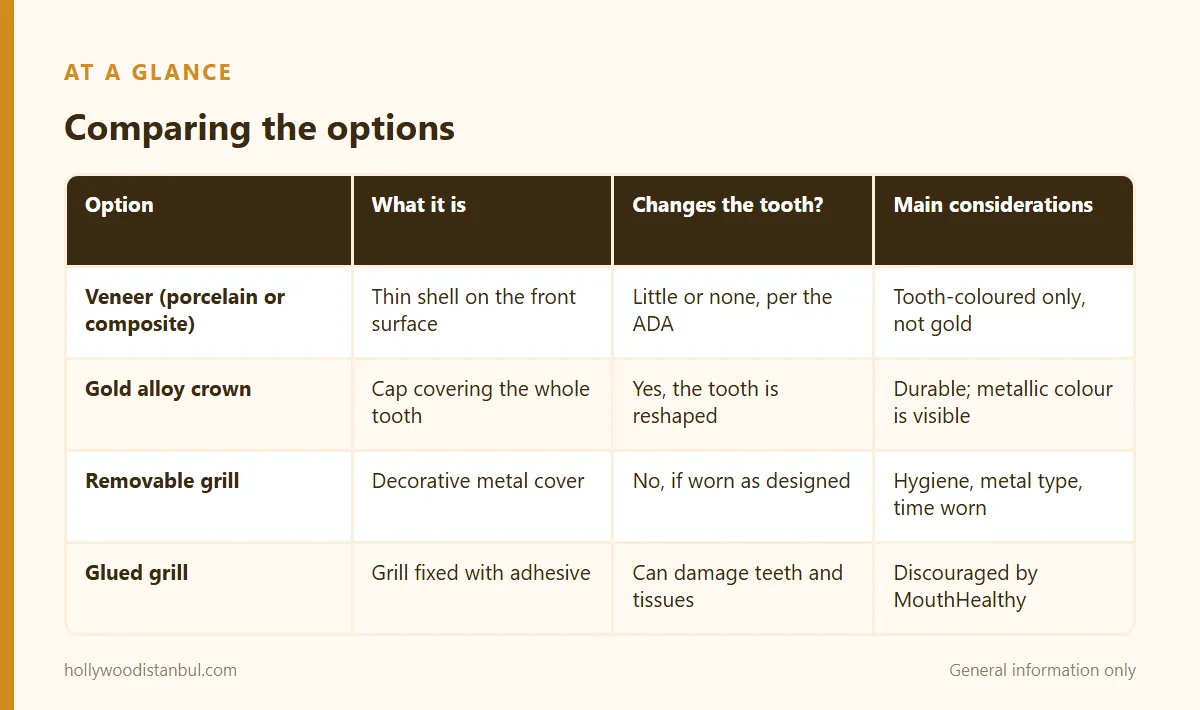
| Option | What it is | Changes the tooth? | Main considerations |
|---|---|---|---|
| Veneer (porcelain or composite) | Thin shell on the front surface | Little or none, per the ADA | Tooth-coloured only, not gold |
| Gold alloy crown | Cap covering the whole tooth | Yes, the tooth is reshaped | Durable; metallic colour is visible |
| Removable grill | Decorative metal cover | No, if worn as designed | Hygiene, metal type, time worn |
| Glued grill | Grill fixed with adhesive | Can damage teeth and tissues | Discouraged by MouthHealthy |
How do you look after a gold crown or grill?
A crown still needs everyday care. The ADA recommends brushing twice a day with fluoride toothpaste and cleaning between the teeth every day. It also points out that a crowned tooth can still decay, and that crowns may chip, fracture or need replacing over time. Cleveland Clinic gives a general lifespan for dental crowns of five to 15 years.
For removable grills, MouthHealthy advises:
- take the grill out before eating
- limit how long you wear it
- clean it daily to remove bacteria and food debris
- don’t use jewellery cleaners or any product that isn’t safe to swallow
- take extra care with brushing and flossing your own teeth
What should you ask before getting one?
MouthHealthy recommends talking to a dentist before getting a grill and finding out exactly what it’s made of. The same applies to a gold crown. Useful questions include:
- Does this tooth need a crown for health reasons, or is this purely cosmetic?
- How much tooth will be removed, and is it reversible?
- What alloy is being used, and does it contain any metals I may react to?
- Who is making the crown or grill, and who is fitting it?
If you go ahead with a crown, you can confirm your practitioner’s registration on the Ahpra public register.
Frequently asked questions
Can a dentist put gold on just the front of my tooth?
Veneers, which cover only the front surface, are made from porcelain or composite resin. A gold-coloured tooth usually means a gold alloy crown, which covers the whole tooth and involves reshaping it.
Are gold grills bad for your teeth?
According to MouthHealthy, there’s no evidence either way on long-term safety. Trapped food and plaque can lead to decay and gum problems, and some base metals can cause irritation or allergic reactions.
Is gold still used for crowns?
Yes. The ADA lists gold alloy as one crown material, and Cleveland Clinic describes metal crowns as hard-wearing and suited to molars that aren’t easily seen.
Can I glue a grill on myself?
MouthHealthy discourages this because glue isn’t meant for use inside the mouth and can damage teeth and tissues.
Sources
- Australian Dental Association, Crowns, bridges and veneers
- Cleveland Clinic, Dental crowns
- American Dental Association (MouthHealthy), Grills
- Ahpra, Register of practitioners
This article is general information and doesn’t replace advice from your own dentist.