Temporary Veneers: During Treatment and Snap-On Types
Dentist-fitted temporaries versus removable snap-on veneers, and how to care for them.
Editorially reviewed.
Temporary veneers usually means one of two things: short-term veneers your dentist fits while your porcelain veneers are made in the lab, or removable “snap-on” veneers sold as a cosmetic cover. The first protects prepared teeth for a few weeks; the second has limited research behind it.
The two are very different products that share a name, so it helps to know which one you are dealing with. This guide covers both, what to expect while you wear dentist-fitted temporaries, and what to consider before buying removable veneers online.
Why do you need temporary veneers during treatment?
Porcelain veneers are made in a dental laboratory, which the Australian Dental Association (ADA) says usually means at least two appointments. Cleveland Clinic explains that after enamel is prepared and impressions are taken, the lab can take a few weeks to make the veneers, and temporary veneers may be placed in the meantime. The Canadian Dental Association describes the same sequence: enamel removed, mould taken, temporary veneers fitted, then the final veneers bonded at a follow-up visit.
Temporaries cover the prepared teeth while you wait for the final veneers. Ask your dentist what yours are made of, how they are attached and how long you will wear them.
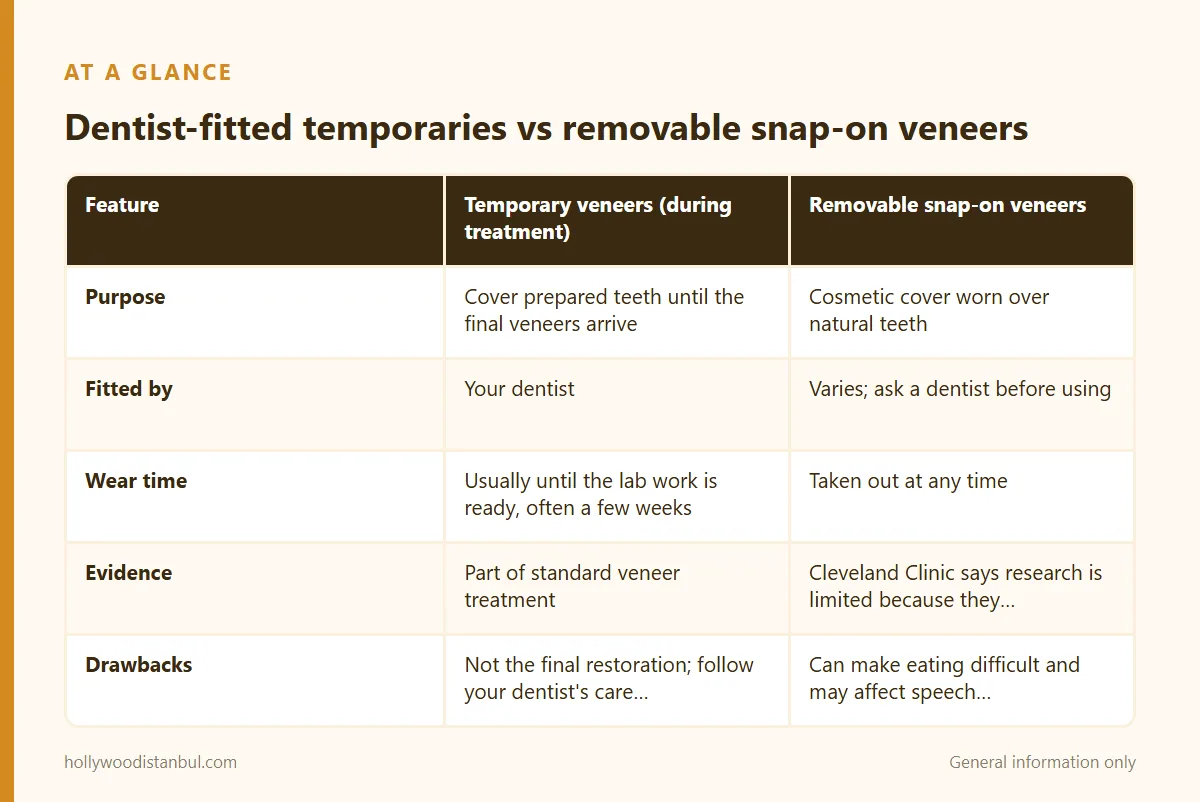
Dentist-fitted temporaries vs removable snap-on veneers
| Feature | Temporary veneers (during treatment) | Removable snap-on veneers |
|---|---|---|
| Purpose | Cover prepared teeth until the final veneers arrive | Cosmetic cover worn over natural teeth |
| Fitted by | Your dentist | Varies; ask a dentist before using |
| Wear time | Usually until the lab work is ready, often a few weeks | Taken out at any time |
| Evidence | Part of standard veneer treatment | Cleveland Clinic says research is limited because they are relatively new |
| Drawbacks | Not the final restoration; follow your dentist’s care instructions | Can make eating difficult and may affect speech (Cleveland Clinic) |
How should you look after temporary veneers?
Your dentist will give instructions specific to your temporaries. General veneer advice still applies:
- Avoid biting hard objects such as ice or fingernails, as the Canadian Dental Association advises for veneered teeth.
- Brush twice a day with fluoride toothpaste and clean between teeth every day, as the ADA recommends for veneers.
- Remember the teeth underneath can still decay.
- Call your dentist promptly if a temporary comes loose or breaks, rather than leaving a prepared tooth exposed.
Are removable veneers a good idea?
They avoid removing enamel, which is their appeal. But Cleveland Clinic notes limited research, possible difficulty eating and possible effects on speech, and recommends asking your dentist whether they are safe for you. If your goal is a short-term change, also consider options a dentist can offer: the ADA notes composite veneers are usually placed in one appointment, and whitening may help if the main issue is colour.
What if you are not ready for permanent veneers?
The Better Health Channel (Victorian Government) warns that once a tooth is cut for a veneer, it may always need one. That makes it reasonable to try reversible steps first. Cleveland Clinic notes no-prep and minimal-prep veneers are described as reversible, though they still need some enamel removal and are not suitable for everyone. Ask your dentist to explain exactly how much enamel each option would remove before anything is prepared.
For a full walk-through of the procedure, see veneers in Australia: procedure and results.
Questions to ask your dentist
- How long will I wear temporary veneers?
- What should I avoid eating while they are on?
- Can I change the shape or shade after seeing the temporaries?
- What happens if a temporary falls off out of hours?
Sources
- Australian Dental Association, Crowns, Bridges and Veneers
- Cleveland Clinic, Dental Veneers
- Canadian Dental Association, Bonding and Veneers
- Better Health Channel (Victorian Government), Cosmetic dentistry and teeth whitening
This article is general information and is not a substitute for advice from your own dentist.