What Happens to the Teeth Under Veneers?
Enamel removal, reversibility, decay and sensitivity: what changes beneath veneers and how to protect those teeth.
Editorially reviewed.

What happens to the teeth under veneers? They stay in place as living teeth, but usually with some enamel removed. That makes most veneers a permanent commitment. The teeth underneath can still decay, may become more sensitive, and will need a new veneer if the old one chips or wears.
Many people worry that veneers “ruin” the teeth underneath. The reality is more nuanced: the main changes happen during preparation, and how the teeth fare afterwards depends heavily on care. This guide explains what changes, what risks remain and how to protect them.
How much tooth is removed for veneers?
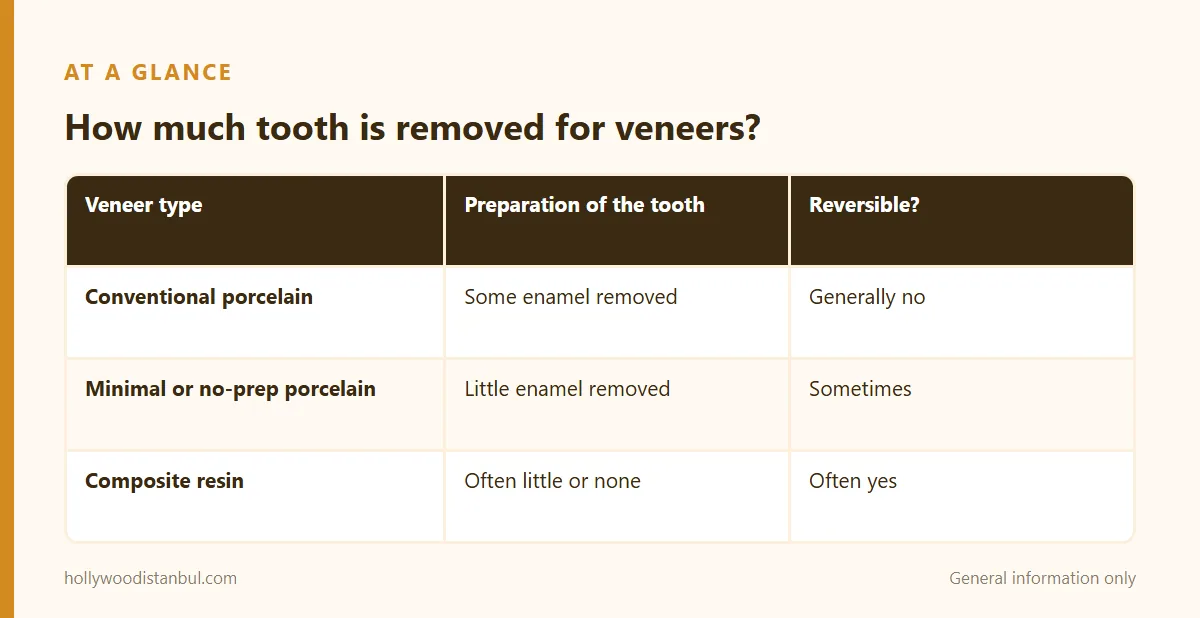
Cleveland Clinic explains that before porcelain veneers are placed, the dentist must remove some enamel from your natural teeth, and that most types of veneers are therefore permanent and not reversible. No-prep or minimal-prep veneers are a less invasive option, but Cleveland Clinic notes that even these still require some enamel removal and are not suitable for everyone.
The Australian Dental Association’s consumer site says that for veneers, not much or no tooth structure has to be cut away, and distinguishes between composite resin veneers, applied directly and shaped by the dentist, and porcelain veneers, made in a dental laboratory.
| Veneer type | Preparation of the tooth | Reversible? |
|---|---|---|
| Conventional porcelain | Some enamel removed | Generally no |
| Minimal or no-prep porcelain | Little enamel removed | Sometimes |
| Composite resin | Often little or none | Often yes |
For more on the materials, see porcelain veneers explained.
Can teeth under veneers still decay?
Yes. Cleveland Clinic states that it is still possible for the natural tooth structure underneath to decay. Decay usually starts at the edge where the veneer meets the tooth, particularly near the gum line. If it is not picked up early, the veneer may need to be removed and the tooth treated, sometimes ending in a crown.
Do teeth become sensitive under veneers?
They can. Cleveland Clinic notes that your teeth may become more sensitive to heat and cold after veneers. This is often temporary after preparation, but in some people it persists. Tell your dentist if sensitivity continues or gets worse.
What happens when a veneer needs replacing?
Cleveland Clinic gives an average lifespan of 10 to 15 years with proper care. The Australian Dental Association’s consumer site notes that crowns, bridges and veneers can chip, fracture or stop matching the colour of the other teeth over time. When a porcelain veneer is replaced, a little more tooth may be removed to fit the new one, which is why the first decision matters. We look at failure points in how long veneers last.
Can the teeth under veneers be healthy long term?
Yes, with good care. Cleveland Clinic says veneers do not actively damage teeth but regular brushing, flossing and dental visits are still needed. It recommends:
- brushing at least twice a day with a non-abrasive fluoride toothpaste and a soft brush
- flossing once a day, paying attention to the veneer edges
- avoiding whitening products, which can scratch veneers
- not using your teeth as tools
- regular check-ups and cleans
If you grind your teeth, ask about a night guard to protect both the veneers and the teeth beneath.
Questions to ask before getting veneers
- How much enamel will be removed from each tooth?
- Would composite or minimal-prep veneers work for my goals?
- What happens if a veneer chips in five or ten years?
- Are my teeth and gums healthy enough now?
- Could whitening, bonding or orthodontics achieve a similar result with less tooth removal?
Frequently asked questions
What do teeth look like under veneers?
Prepared teeth look slightly smaller and flatter at the front, because a thin layer of enamel has been removed to make room for the veneer.
Can you remove veneers and go back to natural teeth?
Usually not with conventional porcelain veneers, because enamel has been removed. Some composite and no-prep veneers can be reversed.
Do veneers stop teeth from decaying?
No. The tooth underneath can still decay, especially at the edges, so cleaning and check-ups remain essential.
Sources
- Cleveland Clinic, Dental Veneers
- Australian Dental Association (Teeth.org.au), Crowns, bridges and veneers
This article is general information and doesn’t replace advice from your own dentist.