Difference Between Veneers and Crowns
Veneers and crowns compared on coverage, purpose, preparation and lifespan.
Editorially reviewed.

The difference between veneers and crowns is coverage and purpose. A veneer is a thin shell on the front of a tooth, mainly cosmetic. A crown is a cap over the whole tooth that strengthens and protects a badly broken, decayed or root-filled tooth.
Both are tooth-coloured options that can make a smile look better, so they are easy to confuse. But they solve different problems, involve different amounts of tooth preparation and age differently. This side-by-side guide helps you understand which one your dentist is likely to suggest, and why.
What is a veneer?
The Australian Dental Association (ADA) describes a veneer as a thin shell of porcelain or composite resin glued to the front surface of a tooth. Veneers suit closing gaps, covering stained, chipped or broken teeth, correcting slightly crooked teeth and reshaping oddly shaped teeth. Because they are very thin, the ADA says little or no tooth structure usually needs removing. Cleveland Clinic adds that veneers are mainly cosmetic and do not strengthen or repair teeth.
What is a crown?
The ADA describes a crown as a cap that fits over a natural tooth after it has been reshaped. It strengthens the tooth, protects what is inside and can improve its appearance. Crowns are used for badly broken, cracked or decayed teeth, and often after root canal treatment, especially on premolars and molars. Materials include porcelain, zirconia, gold alloy or porcelain fused to metal.
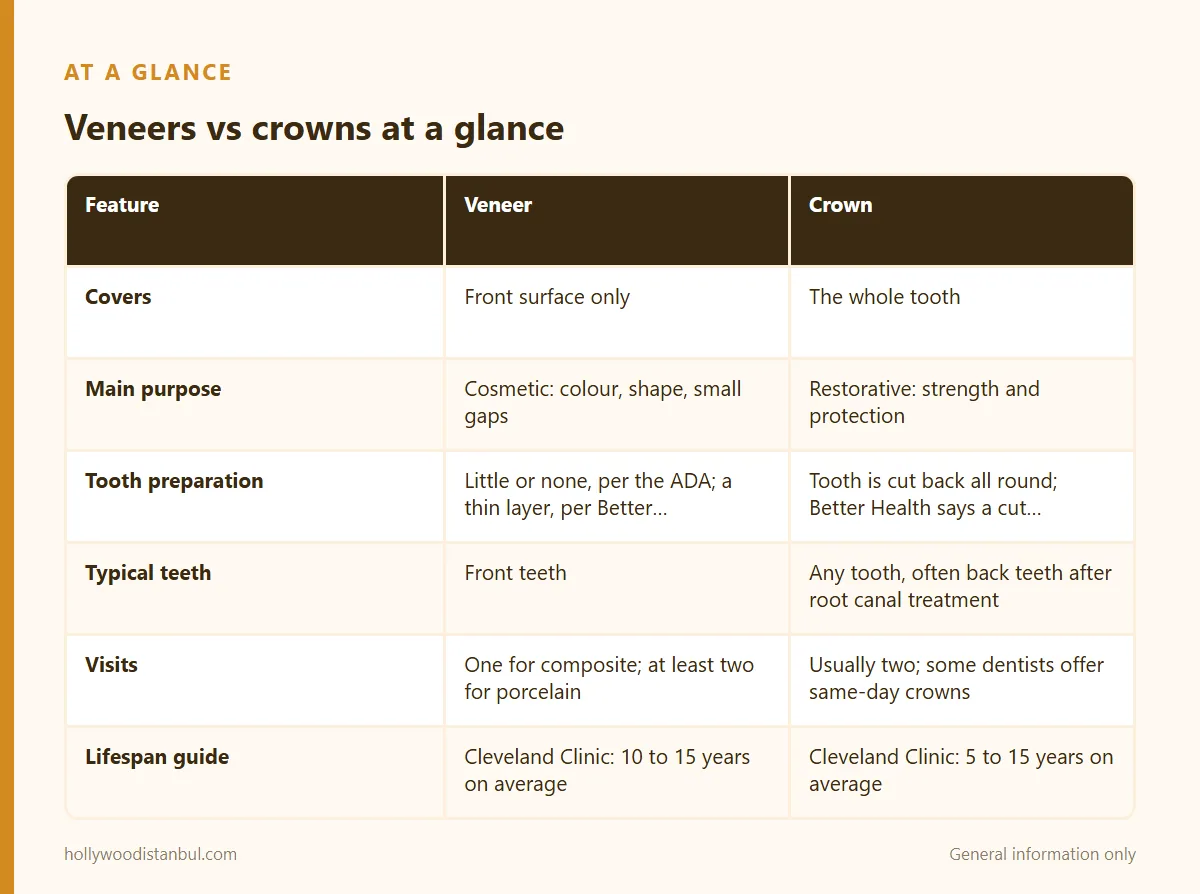
Veneers vs crowns at a glance
| Feature | Veneer | Crown |
|---|---|---|
| Covers | Front surface only | The whole tooth |
| Main purpose | Cosmetic: colour, shape, small gaps | Restorative: strength and protection |
| Tooth preparation | Little or none, per the ADA; a thin layer, per Better Health | Tooth is cut back all round; Better Health says a cut tooth will always need a crown |
| Typical teeth | Front teeth | Any tooth, often back teeth after root canal treatment |
| Visits | One for composite; at least two for porcelain | Usually two; some dentists offer same-day crowns |
| Lifespan guide | Cleveland Clinic: 10 to 15 years on average | Cleveland Clinic: 5 to 15 years on average |
| Main risks | Chipping, breaking, edge staining | Chipping or breaking; deep preparation can lead to root canal treatment |
When does a dentist choose a crown over a veneer?
Usually when the tooth needs strength, not just a new surface. The Canadian Dental Association notes a crown may be needed instead of a veneer when a large part of the tooth is missing. Other common reasons:
- The tooth is badly broken, cracked or decayed.
- The tooth has had root canal treatment, especially a back tooth.
- A large old filling leaves little natural structure.
- There is not enough enamel for a veneer to bond to.
When is a veneer the better fit?
- The tooth is healthy but stained, chipped or slightly misshapen.
- You want to close a small gap between front teeth.
- You want to keep as much natural tooth as possible.
See our guide to dental crown types in Australia for more on materials.
Do either of them stop decay?
No. The ADA stresses that teeth treated with crowns, bridges or veneers can still decay, and the restorations may eventually need repair or replacement. Cleveland Clinic adds that a poorly fitting crown can trap bacteria. Brush twice a day with fluoride toothpaste and clean between your teeth every day.
Questions to ask your dentist
- Does this tooth need strengthening, or just a cosmetic change?
- How much tooth will each option remove?
- Which material do you recommend, and why?
- What will replacement involve later?
For pricing, compare our dental crown cost breakdown with our veneer cost guide.
Sources
- Australian Dental Association, Crowns, Bridges and Veneers
- Better Health Channel (Victorian Government), Cosmetic dentistry and teeth whitening
- Cleveland Clinic, Dental Crowns
- Cleveland Clinic, Dental Veneers
- Canadian Dental Association, Bonding and Veneers
This article is general information and is not a substitute for advice from your own dentist.