How Long Can Veneers Last? Lifespan and Failure Points
Realistic veneer lifespans, why they eventually need replacing and how to protect them.
Editorially reviewed. Dental review: scheduled, not yet completed for this article.

How long can veneers last? Cleveland Clinic gives veneers a lifespan of about 10 to 15 years with proper care, and its tooth discolouration guide quotes a wider five to 15 years. Colgate cites a clinical trial suggesting around ten years. None are permanent: plan on replacing them at some stage.
Where a particular set of veneers lands in that range depends less on luck than on bite forces, habits and maintenance. Knowing the main failure points helps you protect them, and helps you budget realistically before you commit.
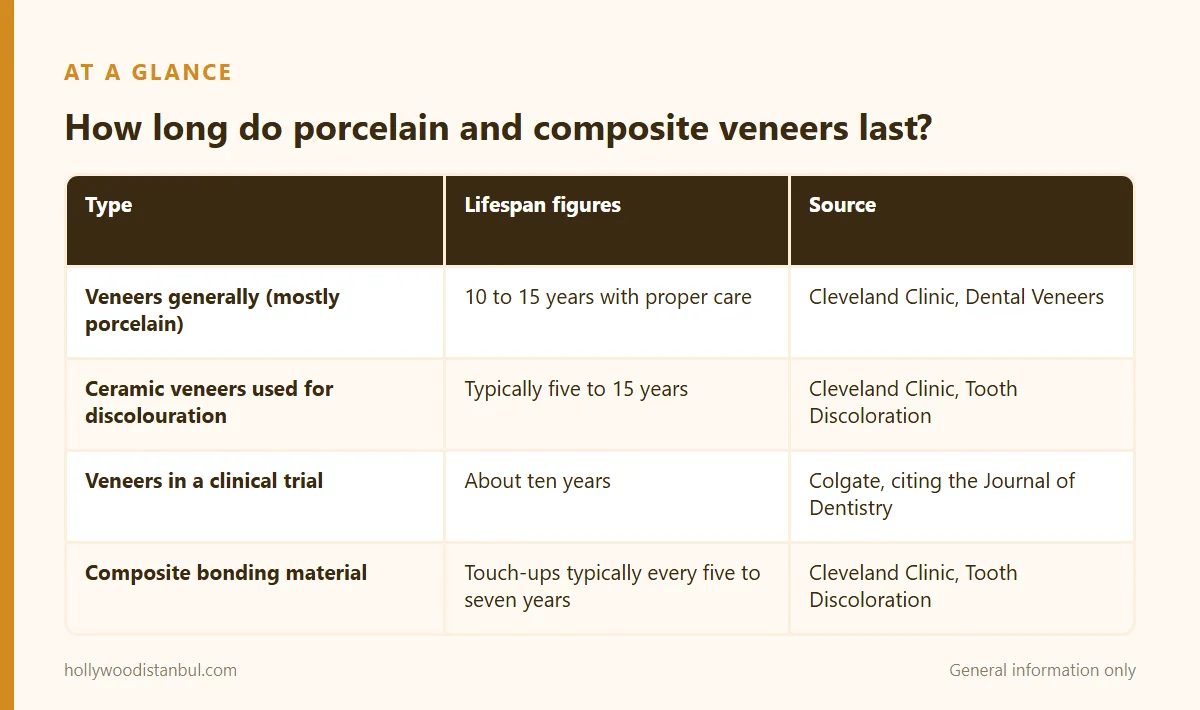
How long do porcelain and composite veneers last?
| Type | Lifespan figures | Source |
|---|---|---|
| Veneers generally (mostly porcelain) | 10 to 15 years with proper care | Cleveland Clinic, Dental Veneers |
| Ceramic veneers used for discolouration | Typically five to 15 years | Cleveland Clinic, Tooth Discoloration |
| Veneers in a clinical trial | About ten years | Colgate, citing the Journal of Dentistry |
| Composite bonding material | Touch-ups typically every five to seven years | Cleveland Clinic, Tooth Discoloration |
Colgate notes that most veneers are made of porcelain, which offers excellent aesthetics and longevity, and that how long they last depends on how they are cared for.
Why do veneers eventually need replacing?
The Australian Dental Association lists the main reasons: veneers can chip, fracture or no longer match the colour of your teeth, and the tooth underneath can still decay. Cleveland Clinic adds that veneers can occasionally come off. The ADA also notes that whitening does not change the colour of porcelain veneers, so if your natural teeth change shade over the years, a mismatch can develop even when the veneers themselves are intact.
Replacement is not optional once you have them. Cleveland Clinic explains that most veneers are permanent, meaning not reversible, because some enamel is removed before placement. Colgate adds that a veneer that has to come off must be replaced with a new one.
What shortens the life of veneers?
- Grinding and clenching. Colgate recommends a night guard if you grind or clench your teeth.
- Biting hard objects and foods. Cleveland Clinic advises cutting hard or crunchy foods and chewing them with back teeth.
- Sports without protection. Colgate recommends a mouthguard for contact sports.
- Abrasive products. Cleveland Clinic warns that whitening products can scratch veneers.
- Staining foods and drinks. Colgate says veneers, like natural teeth, can stain, and suggests limiting coffee, tea, red wine and blueberries.
- Skipped check-ups. Cleveland Clinic recommends keeping up regular dental checkups and cleanings so your dentist can keep an eye on the veneers and the teeth beneath them.
How can you make veneers last as long as possible?
- Brush twice a day with a soft brush and non-abrasive fluoride toothpaste, and floss daily (Cleveland Clinic).
- Wear a night guard if you grind, and a mouthguard for sport.
- Do not use your teeth as tools or chew ice.
- Keep regular check-ups and cleans so your dentist can monitor the margins.
- Before treatment, choose an experienced practitioner. The ADA points out that a dentist cannot be registered as a “cosmetic dentist” in Australia, so ask about training and see examples of their work.
How should lifespan affect your budget?
If veneers last around ten to 15 years, someone getting them in their twenties may need several sets over a lifetime. Asking about replacement cost at the start gives a truer picture than the first quote alone. For current prices, see our guides to how much veneers cost in Australia and the veneer procedure and results.
Does the veneer material change how long they last?
Yes. The Australian Dental Association explains that composite resin veneers are built up directly on the tooth, usually in one visit, while porcelain veneers are made by a technician in a dental laboratory over at least two appointments. Colgate describes porcelain as offering excellent aesthetics and longevity, while Cleveland Clinic says bonded composite typically needs touch-ups every five to seven years. If longevity is your priority, ask your dentist to compare both materials for your bite and habits before deciding.
Sources
- Cleveland Clinic, Dental Veneers
- Cleveland Clinic, Tooth Discoloration
- Colgate, How Long Do Veneers Last?
- Australian Dental Association, Crowns, Bridges and Veneers
This article is general information and is not a substitute for advice from your own dentist.