Teeth Capping: What a Dental Crown Is and When It’s Used
Capping a tooth means fitting a dental crown; here's when it's used, which materials are available and how the two-visit process works.
Editorially reviewed.
Teeth capping is the everyday name for fitting a dental crown: a custom-made, tooth-shaped cover that sits over the whole visible part of a tooth to strengthen it, protect it and improve how it looks. “Cap” and “crown” mean the same restoration, so if your dentist talks about one, they mean the other.
Crowns are among the most common ways dentists rebuild a tooth that is too damaged for a simple filling. They are made to fit over the natural tooth after it has been reshaped, and they can be made from several materials. Below we cover when capping is used, the main material choices, what happens at each appointment and how to look after a capped tooth so it lasts.
What does capping a tooth actually involve?
A crown fits over the entire tooth above the gum line. To make room for it, the dentist removes a small amount of the outer tooth structure, so the crown can sit at a natural size and line up with your bite. Once it is cemented in place, the crown takes the chewing load and shields the remaining tooth underneath.
This is different from a veneer. Veneers are thin shells that cover only the front surface of a tooth and are mainly cosmetic, while crowns cover the whole tooth and are mainly restorative. Inlays and onlays sit in between: they are used when a tooth is too damaged for a filling but doesn’t need full coverage.
When is a crown used?
According to the Australian Dental Association, crowns are used to repair teeth that are badly broken, cracked or decayed, and they are commonly placed on teeth that have had root canal treatment, especially premolars and molars. Cleveland Clinic lists several other reasons a dentist may suggest one:
- strengthening a weak tooth or supporting a cracked one
- restoring a tooth that is worn down or broken
- holding a dental bridge in place
- covering a severely stained or discoloured tooth
- covering a dental implant or a root canal-treated tooth
Whether a crown is the right option for a particular tooth depends on how much healthy structure is left, where the tooth sits in the mouth and how you bite. Only an examination can answer that. If a tooth is too damaged for a crown to be predictable, removal and replacement (for example with an implant) may be discussed instead.
Crown materials compared
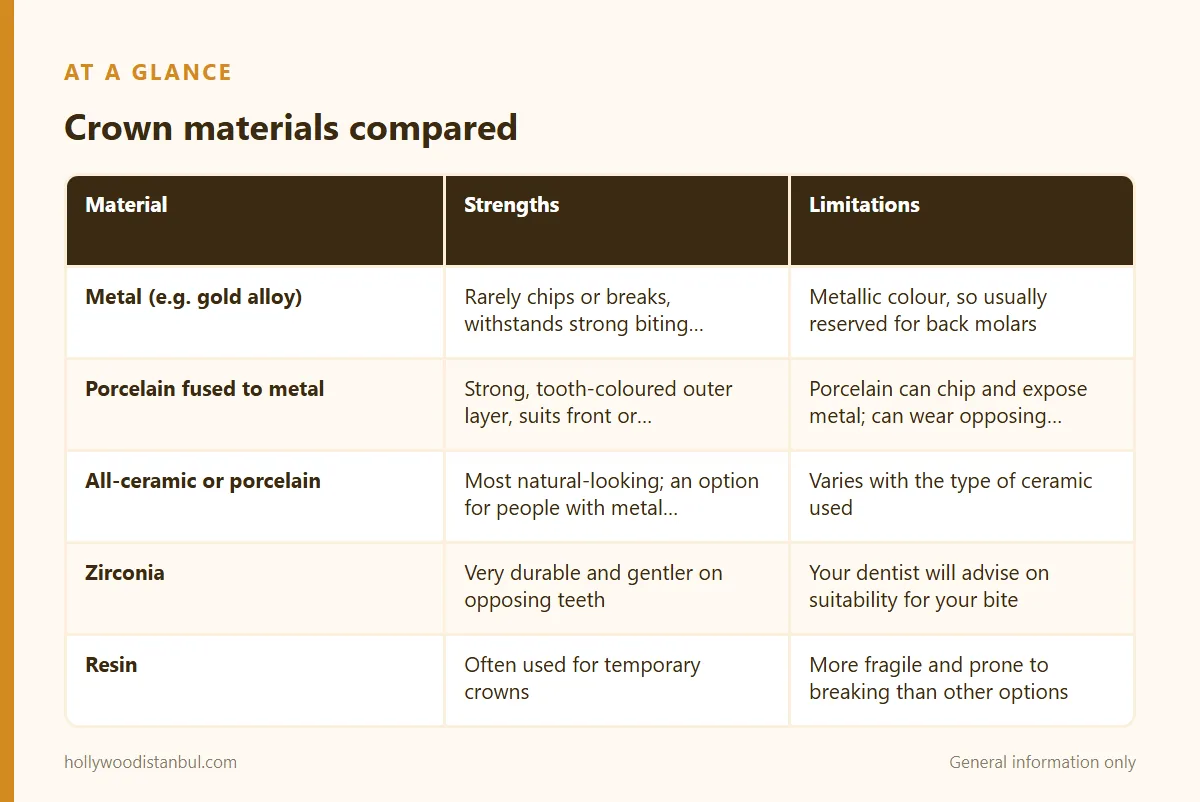
The ADA lists porcelain, zirconia, gold alloy and porcelain fused to metal as the usual crown materials, noting that porcelain and zirconia can be colour-matched to your other teeth. Each has trade-offs, summarised from Cleveland Clinic’s guide:
| Material | Strengths | Limitations |
|---|---|---|
| Metal (e.g. gold alloy) | Rarely chips or breaks, withstands strong biting forces, needs little tooth removal | Metallic colour, so usually reserved for back molars |
| Porcelain fused to metal | Strong, tooth-coloured outer layer, suits front or back teeth | Porcelain can chip and expose metal; can wear opposing teeth |
| All-ceramic or porcelain | Most natural-looking; an option for people with metal allergies | Varies with the type of ceramic used |
| Zirconia | Very durable and gentler on opposing teeth | Your dentist will advise on suitability for your bite |
| Resin | Often used for temporary crowns | More fragile and prone to breaking than other options |
For a closer look at how these compare, see our guide to dental crown types in Australia.
The capping process, step by step
Most crowns take two appointments. At the first visit, the dentist reshapes the tooth and, if needed, builds it up with filling material to give the crown a stable base. A copy of the tooth is then taken, either as a physical impression or as a digital 3D scan, and sent to a dental technician who makes the crown. Cleveland Clinic notes that lab work usually takes two to three weeks, so a temporary crown is fitted to protect the tooth in the meantime.
At the second visit, the temporary crown comes off. The dentist checks the shape, colour and fit of the permanent crown, then cements it onto the tooth.
Some practices offer same-day crowns. These are designed from digital scans and milled from a solid block of ceramic by a machine in the clinic, so the whole process can be completed in one visit. Not every tooth or patient is suited to this approach. We walk through both visits in more detail in Dental Crown Procedure: Two Visits, Step by Step.
After the crown is fitted
Most people go back to normal activities straight away. Cleveland Clinic says some sensitivity to heat and cold is normal for a couple of weeks, and gum soreness usually fades within a few days. A crown itself shouldn’t be painful, though, so ongoing pain or discomfort is a reason to contact your dentist.
Other signs worth reporting include a crown that feels loose, a bad taste or bad breath around the tooth, visible cracks or chips, and sharp edges that rub your tongue or gums.
Caring for a capped tooth
A crown doesn’t make a tooth immune to problems. The ADA points out that the tooth underneath can still decay, and crowns can chip, fracture or stop matching the colour of nearby teeth, which may mean replacement. Day-to-day care is the same as for natural teeth:
- brush twice a day with fluoride toothpaste and a soft-bristled brush
- clean between your teeth every day
- go easy on ice, very hard nuts, popcorn kernels and very sticky lollies, which can damage or dislodge both temporary and permanent crowns
- ask about a custom night guard if you grind or clench
- keep up regular check-ups and professional cleans
With good care, Cleveland Clinic gives an average lifespan of around five to 15 years, and notes that some crowns last much longer. Any crown showing wear, cracking or damage should be checked.
Frequently asked questions
Is a cap the same as a crown?
Yes. “Dental cap” and “crown” describe the same restoration: a tooth-shaped cover that fits over the whole tooth.
Who can fit a crown in Australia?
The ADA says crowns can be provided by a general dentist or by a prosthodontist, a dental specialist in restoring and replacing teeth.
Does getting a tooth capped hurt?
The tooth is numbed while it’s prepared, and you can ask for more anaesthetic if you feel anything. Some temporary sensitivity afterwards is common, but lasting pain should be checked by your dentist.
Can a capped tooth be whitened?
No. Whitening gels only lighten natural enamel and don’t change the colour of porcelain or zirconia crowns, so any whitening is usually planned before a front crown is made.
Sources
- Australian Dental Association (teeth.org.au), Crowns, bridges and veneers
- Cleveland Clinic, Dental Crowns: Types, Procedure & Care
- Australian Dental Association (teeth.org.au), Teeth whitening
This article is general information and doesn’t replace advice from your own dentist.