Should I Get Veneers? A Step-by-Step Decision Guide
A step-by-step checklist to decide whether veneers suit your teeth and goals.
Editorially reviewed.

Should I get veneers? They can suit healthy teeth with stains, chips, small gaps or uneven shapes. They are a poor fit if you have untreated decay or gum disease, grind your teeth, or aren’t ready for a likely permanent change.
Veneers are a big commitment: they cost a lot, usually involve some enamel removal and need replacing over a lifetime. This decision guide walks you through the questions to ask yourself, and your dentist, before you book.
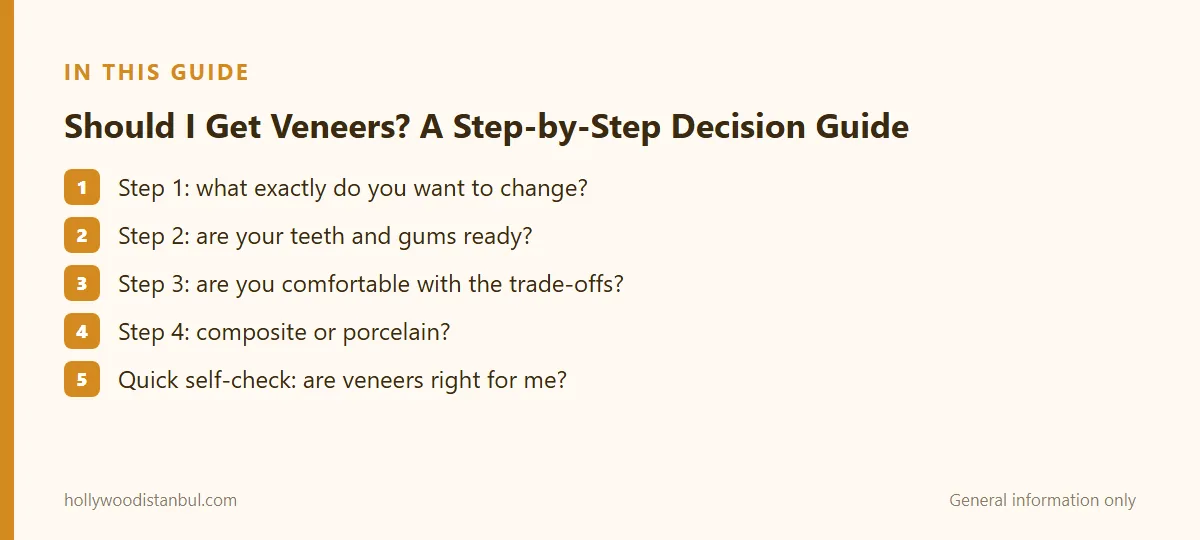
Step 1: what exactly do you want to change?
The Better Health Channel (Victorian Government) suggests starting by thinking about what you want changed, along with any symptoms, past treatment, budget, insurance and how much home care you can commit to. The Australian Dental Association (ADA) lists what veneers are suited to:
- closing gaps between front teeth
- covering stained, discoloured, broken or chipped teeth
- correcting slightly crooked teeth
- reshaping oddly shaped teeth
If your main concern is colour alone, whitening may be worth trying first. If teeth are significantly crooked, orthodontics may be a better starting point.
Step 2: are your teeth and gums ready?
Better Health advises a full check of your mouth and treating any disease before cosmetic work. Cleveland Clinic says people with extensive cavities or gum disease should have these treated first. The Canadian Dental Association adds that dentists may suggest other treatment if there is not enough enamel to bond to, a large part of the tooth is missing (a crown may be needed) or you grind or clench your teeth.
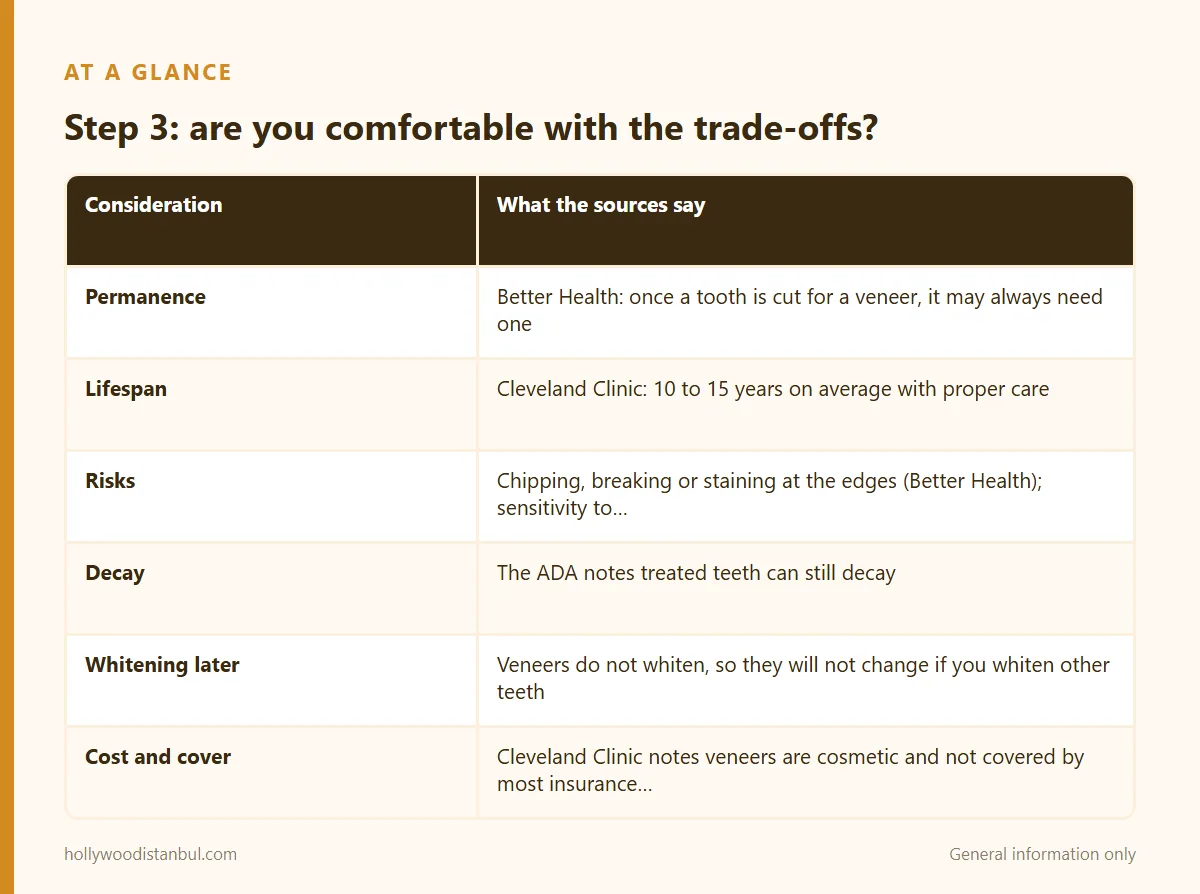
Step 3: are you comfortable with the trade-offs?
| Consideration | What the sources say |
|---|---|
| Permanence | Better Health: once a tooth is cut for a veneer, it may always need one |
| Lifespan | Cleveland Clinic: 10 to 15 years on average with proper care |
| Risks | Chipping, breaking or staining at the edges (Better Health); sensitivity to heat and cold, or a veneer coming off (Cleveland Clinic) |
| Decay | The ADA notes treated teeth can still decay |
| Whitening later | Veneers do not whiten, so they will not change if you whiten other teeth |
| Cost and cover | Cleveland Clinic notes veneers are cosmetic and not covered by most insurance plans |
Step 4: composite or porcelain?
The ADA explains composite veneers are shaped directly on the tooth, usually in one appointment, while porcelain veneers are made in a lab and usually need at least two. The Canadian Dental Association says porcelain generally lasts longer and resists stains better. Ask your dentist which suits your teeth and budget.
Step 5: choose your dentist carefully
Better Health points out that “cosmetic dentist” is not an official title in Australia; dentists are registered as general dentists or specialists. Complex cases may need referral to a specialist. Ask about:
- the options and their pros and cons
- realistic results for your teeth
- total costs and payment options
- side effects and what happens if something goes wrong
- how much enamel will be removed from each tooth
Our guide to choosing cosmetic dentists in Australia and our veneer cost guide can help with the practical side.
Quick self-check: are veneers right for me?
- My teeth and gums have been checked and any problems treated.
- I have considered whitening, bonding or orthodontics.
- I understand the change is likely permanent.
- I can budget for replacement in the future.
- I am willing to brush, clean between teeth and attend check-ups.
- I do not grind my teeth, or I have discussed it with my dentist.
If you can tick most of these, veneers may be worth discussing in detail. If not, start with the simpler options.
Sources
- Better Health Channel (Victorian Government), Cosmetic dentistry and teeth whitening
- Australian Dental Association, Crowns, Bridges and Veneers
- Cleveland Clinic, Dental Veneers
- Canadian Dental Association, Bonding and Veneers
This article is general information and is not a substitute for advice from your own dentist.