Composite Veneers: What the Resin Can and Can’t Do
How composite resin veneers are placed, how they compare with porcelain and how to make them last.
Editorially reviewed. Dental review: scheduled, not yet completed for this article.

Composite veneers are layers of tooth-coloured resin that a dentist applies directly to the front of a tooth and shapes by hand, usually in a single visit. They can mask chips, small gaps and discolouration, but they generally stain and chip more easily than porcelain.
For many Australians looking at cosmetic work, composite veneers sit between simple bonding and lab-made porcelain shells. Understanding how the material behaves helps you decide whether it suits your teeth, your habits and how long you want the result to last before maintenance.
How are composite veneers made and placed?
The key difference from porcelain is where the veneer is made. The Australian Dental Association explains that a composite resin veneer is applied directly to the front surface of the tooth and shaped by the dentist, and is usually completed in one visit. Porcelain veneers, by contrast, are made by a technician in a dental laboratory and usually need at least two appointments.
Cleveland Clinic notes that composite veneers use the same tooth-coloured resin as dental bonding and that no dental impressions are needed. Colgate’s overview of composite bonding describes the general steps:
- The tooth surface is smoothed and a conditioning liquid is applied so the resin can bond.
- The resin is placed and hardened with a special curing light.
- The dentist shapes and polishes the material, then checks your bite.
Colgate, citing Cleveland Clinic, says bonding a single tooth typically takes between half an hour and an hour, and local anaesthetic may not be needed. Treating several front teeth with veneers will naturally take longer.
What problems can composite veneers address?
The ADA lists the situations where veneers in general are used: closing gaps between front teeth, covering stained, discoloured, broken or chipped teeth, and improving slightly crooked or oddly shaped teeth. Cleveland Clinic describes composite veneers specifically as a way to conceal mild cosmetic issues.
That word “mild” matters. Colgate notes that bonding is less suitable if your bite needs correcting, for example with a significant overbite or overjet, or if there is too little natural tooth left to build on. In those cases a dentist may suggest orthodontics, crowns or porcelain instead.
Composite veneers vs porcelain: how do they compare?
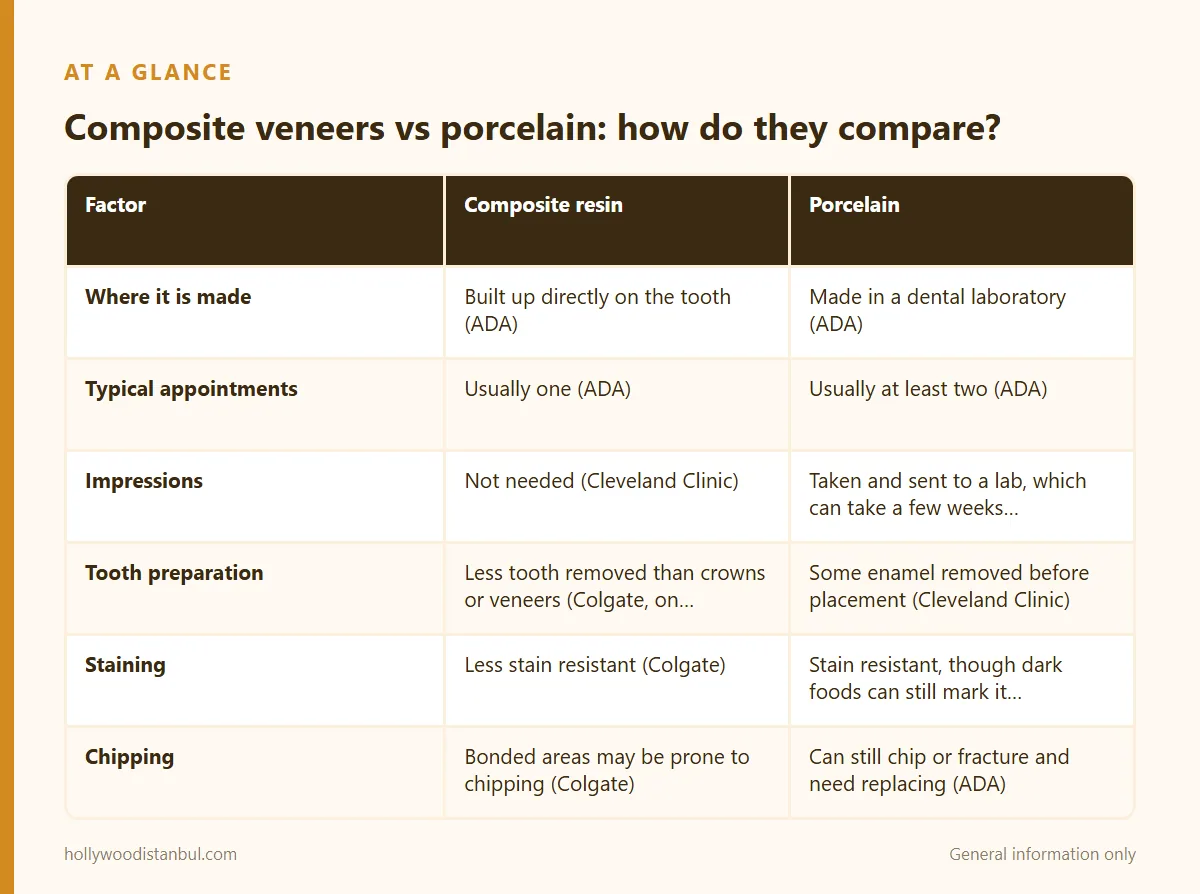
| Factor | Composite resin | Porcelain |
|---|---|---|
| Where it is made | Built up directly on the tooth (ADA) | Made in a dental laboratory (ADA) |
| Typical appointments | Usually one (ADA) | Usually at least two (ADA) |
| Impressions | Not needed (Cleveland Clinic) | Taken and sent to a lab, which can take a few weeks (Cleveland Clinic) |
| Tooth preparation | Less tooth removed than crowns or veneers (Colgate, on bonding) | Some enamel removed before placement (Cleveland Clinic) |
| Staining | Less stain resistant (Colgate) | Stain resistant, though dark foods can still mark it over time (Cleveland Clinic) |
| Chipping | Bonded areas may be prone to chipping (Colgate) | Can still chip or fracture and need replacing (ADA) |
How much tooth is removed?
One reason people choose veneers over crowns is that less of the tooth is cut away. The Australian Dental Association explains that veneers are very thin, so little or no tooth structure has to be removed, whereas a crown covers the whole tooth after it has been cut back. Even so, the ADA points out that having a veneer does not mean the tooth will never need further treatment, so ask your dentist what would be involved if the veneer chipped or had to be replaced in future.
How long do composite veneers last?
Lifespan depends heavily on habits. Colgate, citing Cleveland Clinic, says composite bonding materials can last between three and 10 years depending on your oral hygiene. Cleveland Clinic gives a general figure of 10 to 15 years for veneers with proper care, a range that mostly reflects porcelain. The ADA adds a realistic reminder that applies to both: having a veneer does not mean no further treatment will ever be needed. Veneers can chip, fracture or stop matching the colour of your teeth and need replacing, and the tooth underneath can still decay.
If you are considering whitening, timing matters. The ADA states that whitening will not change the colour of composite resin, so whitening is usually done before composite is matched to your teeth, not after.
How do you look after composite veneers?
- Brush twice a day with a soft brush and a non-abrasive fluoride toothpaste, and clean between your teeth daily (Colgate, Cleveland Clinic).
- Do not chew pens, ice or fingernails, and do not bite hard foods with your front teeth.
- If you grind your teeth, ask your dentist about a night guard.
- Limit coffee, tea, red wine and berries, which Cleveland Clinic lists as staining culprits for veneers.
- Keep regular check-ups so small chips or rough edges can be polished or repaired early.
Cleveland Clinic also points out that veneers are only an option if you are free of extensive decay and gum disease, so a check-up is the right first step. For a look at how the procedure fits into broader cosmetic plans, see our guide to veneers in Australia and our explainer on composite bonding.
One more point from the ADA worth knowing when you compare practices: a dentist cannot be registered as a “cosmetic dentist” in Australia. Veneers are provided by general dentists and by prosthodontists, so ask about their experience with veneers and for a written treatment plan before you agree to treatment.
Sources
- Australian Dental Association, Crowns, Bridges and Veneers
- Australian Dental Association, Teeth Whitening
- Cleveland Clinic, Dental Veneers
- Colgate, Is Composite Resin Bonding Right For You?
This article is general information and is not a substitute for advice from your own dentist.