Maryland Bridge: How a Resin-Bonded Dental Bridge Works
How resin-bonded Maryland bridges work, who they suit, what studies show about failure and debonding, and how to care for one.
Editorially reviewed.

A Maryland bridge (dental resin-bonded bridge) replaces a missing tooth with a false tooth attached to small metal or ceramic wings that are glued to the back of the neighbouring teeth. It needs little drilling and is mostly used for front teeth.
Because it preserves the neighbouring teeth, a Maryland bridge is often considered for younger adults or for a single missing front tooth. This guide explains how it works, who it suits, what the research says and how it compares with other options in Australia.
How does a Maryland bridge work?
Cleveland Clinic explains that a Maryland (resin-bonded) bridge uses metal wings instead of crowns to secure the bridge, bonded to the backs of the neighbouring teeth. The false tooth (pontic) sits in the gap, and the wings spread the load onto the teeth either side. The Oral Health Foundation describes these adhesive bridges as needing very little drilling, and notes they are often used for front teeth, where biting forces are lighter.
A conventional bridge, by contrast, uses crowns on the neighbouring teeth, which means cutting them back. Our guide to how dental bridges work covers the conventional type.
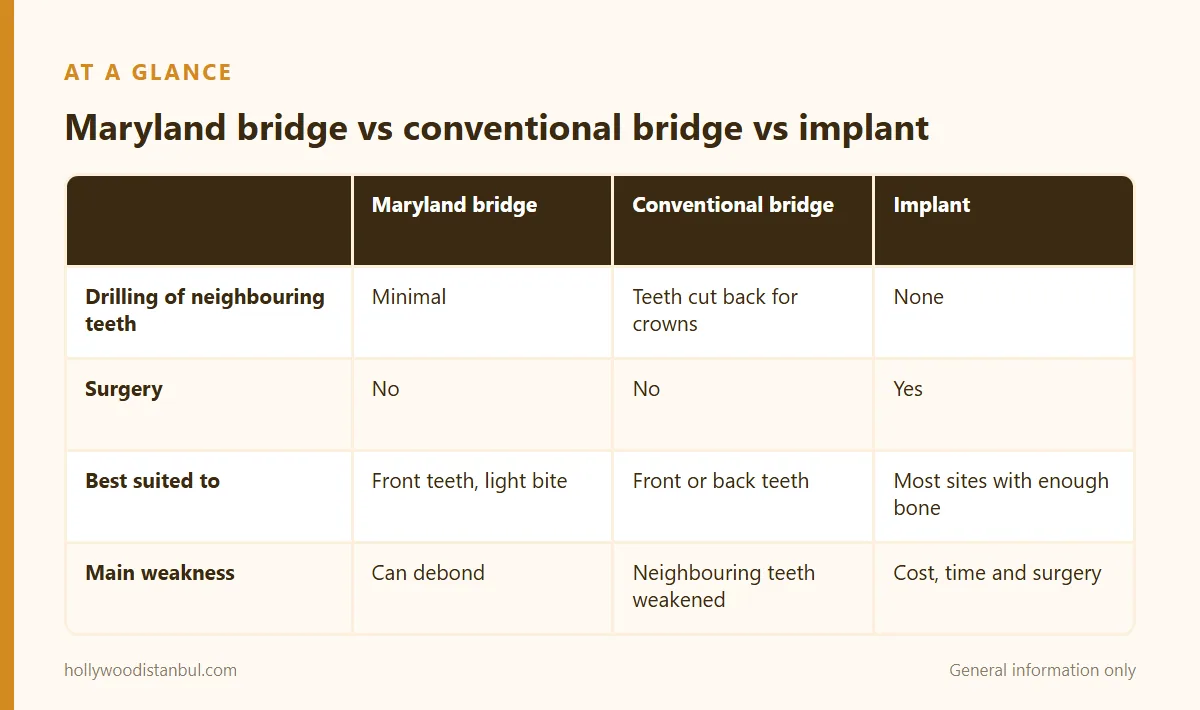
Maryland bridge vs conventional bridge vs implant
| Maryland bridge | Conventional bridge | Implant | |
|---|---|---|---|
| Drilling of neighbouring teeth | Minimal | Teeth cut back for crowns | None |
| Surgery | No | No | Yes |
| Best suited to | Front teeth, light bite | Front or back teeth | Most sites with enough bone |
| Main weakness | Can debond | Neighbouring teeth weakened | Cost, time and surgery |
Who is a Maryland bridge suitable for?
Cleveland Clinic says Maryland bridges are typically used for front teeth because they cannot handle the chewing forces on back teeth. It also notes that most dentists do not place bridges in people under 17 or 18, although there are exceptions. A Maryland bridge tends to suit:
- a single missing front tooth
- healthy neighbouring teeth with enough enamel to bond to
- a bite that does not put heavy force on the gap
- people who want to avoid surgery or cutting down healthy teeth
It is less suitable for people who grind their teeth heavily, have a deep bite at the front, or have neighbouring teeth with large fillings.
What does the research show?
A summary from the National Elf Service of a 2016 systematic review in the Journal of Dentistry notes that reported survival rates for resin-bonded bridges range widely, from 59% to the top of the scale. The review found that front-tooth bridges with a single wing (a cantilever design) had lower failure rates than those bonded to teeth on both sides. Debonding rates were not significantly different between the designs. All the included studies had a high risk of bias, so the findings should be read with caution.
If you are offered a Maryland bridge, it is reasonable to ask whether a one-wing or two-wing design is planned, and why.
What happens when you get a Maryland bridge?
Cleveland Clinic describes two visits: the first to prepare the teeth and take impressions, and the second to fit the bridge and bond the wings. Preparation is usually minimal, sometimes just light shaping of the back of the tooth so the wing sits flush.
How do you look after a Maryland bridge?
- Clean under the false tooth daily with floss threaders or small interdental brushes.
- Avoid biting directly into hard foods with the bridged tooth.
- See your dentist promptly if the bridge feels loose; a debonded bridge can often be re-cemented.
- Keep regular check-ups so the bonded teeth can be checked for decay.
For Australian price factors, see dental bridge cost in Australia.
Frequently asked questions
How long does a Maryland bridge last?
It varies widely. Studies report a broad range, and debonding is the most common problem, though a loose bridge can often be re-bonded.
Can a Maryland bridge be used for back teeth?
Usually not. Cleveland Clinic notes they cannot handle back-tooth chewing forces.
Is a Maryland bridge a good option before an implant?
It can be, because it involves little preparation of the neighbouring teeth. Ask your dentist whether it suits your timing and bite.
Sources
- Cleveland Clinic, Dental Bridges
- Oral Health Foundation, Bridges
- National Elf Service, Resin-bonded fixed dental prostheses
This article is general information and doesn’t replace advice from your own dentist.