How Much Is a Filling in Australia? Fees and Item Numbers
Average filling fees by item number, what drives the price and what to ask before treatment.
Editorially reviewed. Dental review: scheduled, not yet completed for this article.

How much is a filling in Australia? According to CHOICE, which reported the Australian Dental Association’s 2022 fee survey, the average one-surface filling cost about $167 on a front tooth and $178 on a back tooth, with two-surface fillings averaging around $202 to $220.
Those are averages from a national survey, not a quote, and fees have likely moved since 2022. The useful part is understanding why one filling can cost noticeably more than another, how dental item numbers work, and what to ask before you sit in the chair.
What did the ADA fee survey find for fillings?
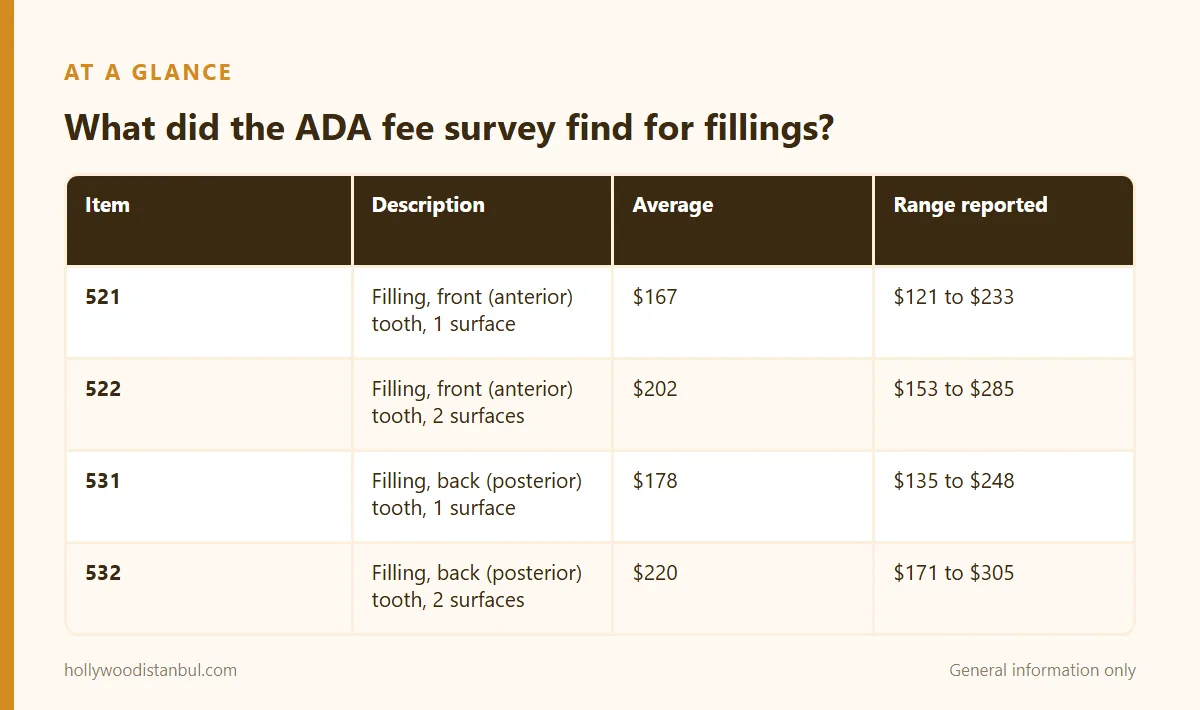
CHOICE published the following general dentist averages from the ADA’s 2022 survey, with the top and bottom 5% of prices excluded. Each line is identified by an item number from the Australian Schedule of Dental Services, the coding system practices and health funds use.
| Item | Description | Average | Range reported |
|---|---|---|---|
| 521 | Filling, front (anterior) tooth, 1 surface | $167 | $121 to $233 |
| 522 | Filling, front (anterior) tooth, 2 surfaces | $202 | $153 to $285 |
| 531 | Filling, back (posterior) tooth, 1 surface | $178 | $135 to $248 |
| 532 | Filling, back (posterior) tooth, 2 surfaces | $220 | $171 to $305 |
CHOICE also reported a state spread for fillings, from about $148 in Queensland to $183 in Tasmania. Keep in mind the filling is rarely the only item on the bill, which brings us to the next point.
Why does the final bill vary so much?
Several things push the price of a filling up or down:
- Number of surfaces. The survey figures show that a two-surface filling costs more than a one-surface filling on the same tooth.
- Front or back tooth. Back teeth (items 531 and 532) averaged slightly more than front teeth.
- Material. The ADA explains that composite resin, glass-ionomer cement, amalgam, gold and porcelain all have different uses. Gold and porcelain fillings are made in a laboratory and often take at least two appointments, which is reflected in cost.
- The examination and X-rays. If the filling is found at a check-up, the bill may also include an exam and X-rays. CHOICE lists a periodic exam (item 012) at an average of $60 and an X-ray at about $45 per exposure in the same survey.
- Location and practice. Fees are set by each practice, so prices differ between suburbs and states.
Which filling material will a dentist suggest?
The Australian Dental Association says the choice depends on where the tooth is in your mouth, how your teeth bite together, and the size of the filling. Its summary of the main options:
- Composite resin: tooth-coloured and bonded to the tooth, so less tooth structure needs removing. Suitable for front and back teeth.
- Glass-ionomer cement: tooth-coloured and contains fluoride, but not as strong as composite. Often used for temporary fillings.
- Amalgam: strong and long lasting but needs more tooth removed. The ADA notes it is not commonly used now and some dentists do not use it at all.
- Gold and porcelain inlays: made outside the mouth, very strong and long lasting, and usually more expensive.
Can a health fund or public scheme help with the cost?
Private extras cover may pay a rebate on fillings, but the amount depends on your fund, your policy and the item number, and annual limits apply. CHOICE recommends checking annual and lifetime limits and waiting periods before buying a policy. For eligible people, CHOICE notes that public dental care and the Child Dental Benefits Schedule, for children aged 2 to 17, can cover basic treatment, although CHOICE also notes that public care is available only to a limited part of the population and waitlists can be long. Our guide to free dental care in Australia explains who qualifies, and the Better Health Channel lists public dental services available in Victoria.
What should you ask before getting a filling?
- Which item numbers will be charged? With the codes, you can ask your health fund what rebate to expect.
- Which material is being recommended, and why for this particular tooth?
- Are X-rays or an exam included, or billed separately?
- If several fillings are needed, can the total be confirmed in writing first? CHOICE suggests asking for item numbers and comparing quotes for larger treatment plans.
It also helps to know what you are paying for in the long run. The ADA points out that fillings do not last forever: the join between tooth and filling can open over time, letting bacteria in. Better Health adds that all fillings need replacing eventually, and regular check-ups can catch worn ones early. Treating small cavities promptly is usually cheaper than waiting until a tooth needs a crown or root canal. For a wider look at costs, see our guide to what a dentist visit costs in Australia.
Sources
- CHOICE, How much does the dentist cost? (ADA 2022 fee survey data)
- Australian Dental Association, Fillings
- Better Health Channel (Victorian Government), Dental fillings
This article is general information and is not a substitute for advice from your own dentist.